Righting Historic Wrongs—Recreating a Cascade River


 Lorne Fitch, P. Biol.

The past didn’t go anywhere, it’s still with us—disguised, diminished and discarded, like a dry river channel. It is a reminder of where we were at a point in time. Utah Phillips, folksinger and poet, reminded us of this when he said if you drop an old rock on your toe it’s the past catching up with you. Like the rock, the past is never past. It sits there giving us advice on the future, maybe showing us a place to which we need to return.

The extensive manipulation of water in the Bow River watershed for electricity generation is something we now take for granted. Electricity is like magic, so much so we have lives of ease, comfort and convenience because of it.  But there have been consequences. 

Tourists driving north of the townsite of Banff, arriving at Lake Minnewanka might be surprised it isn’t a lake anymore, but a hydropower reservoir.  Three successive dams, culminating with the last in 1941, raised water levels by thirty metres.

The final dam topped off twenty years of political and corporate intrigue between advocates of power production and those attempting to protect national park interests. In some influential jiggery-pokery, the National Parks Act was suspended by the War Measures Act with the rationale the power was needed to meet the war effort. How providing power to Banff townsite was part of the vital needs of World War Two is not clear.  As is the usual case, power trumped protection. 

Native legend relays that a warrior saw a fish in its waters as long as the lake. There was respect and fear for the resident evil water spirit. I sense we have had more to fear from modern engineering spirits than any malevolent fish ones. 

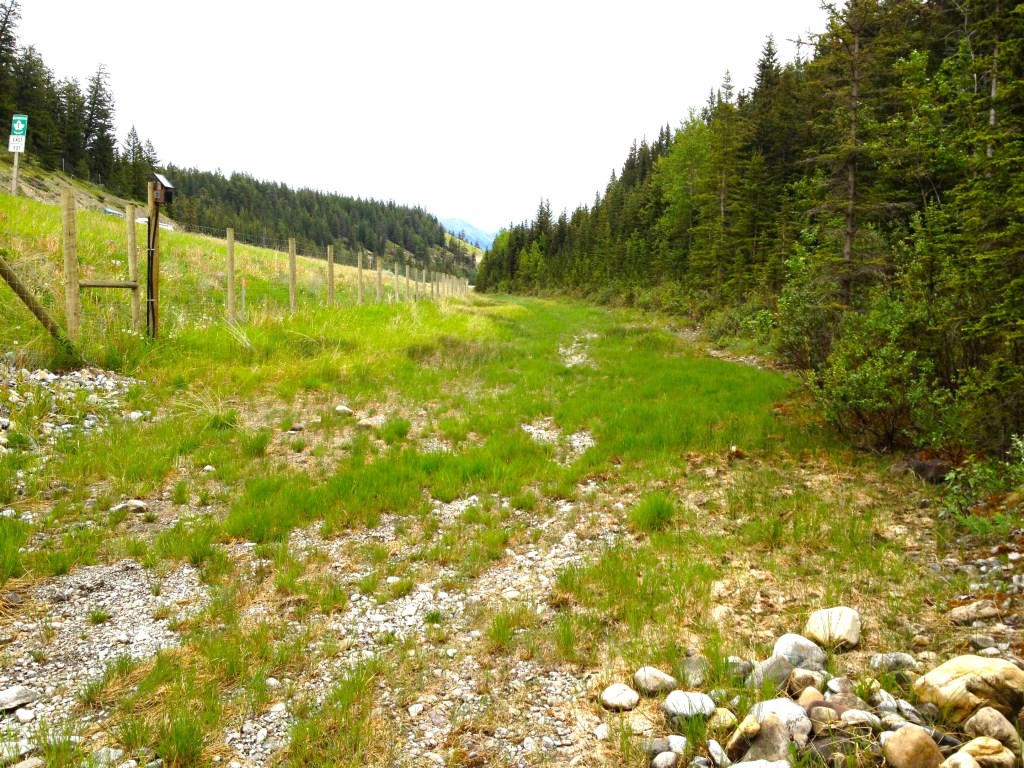
Two rivers were negatively influenced by engineering spirits to accomplish electrical generation, the Cascade and Ghost rivers. The Cascade River was diverted away from its historic course, drying it up most of the time. Both rivers were home to native Westslope cutthroat and bull trout. For a variety of reasons, including the manipulation of river systems for electrical generation, both these species are categorized as Threatened.

In the Cascade River, neither cutthroat or bull trout adapted to a dry channel with periodic trickles of water, estimated to be about one per cent of former flows. Several millennia of evolution still have not created a fish that can live without water.

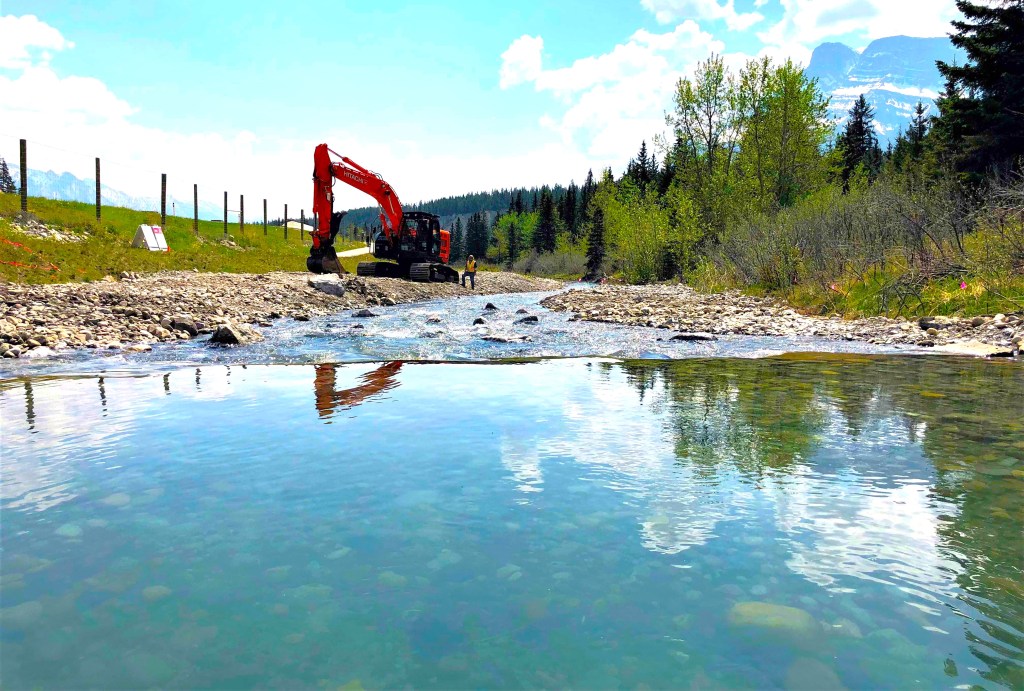
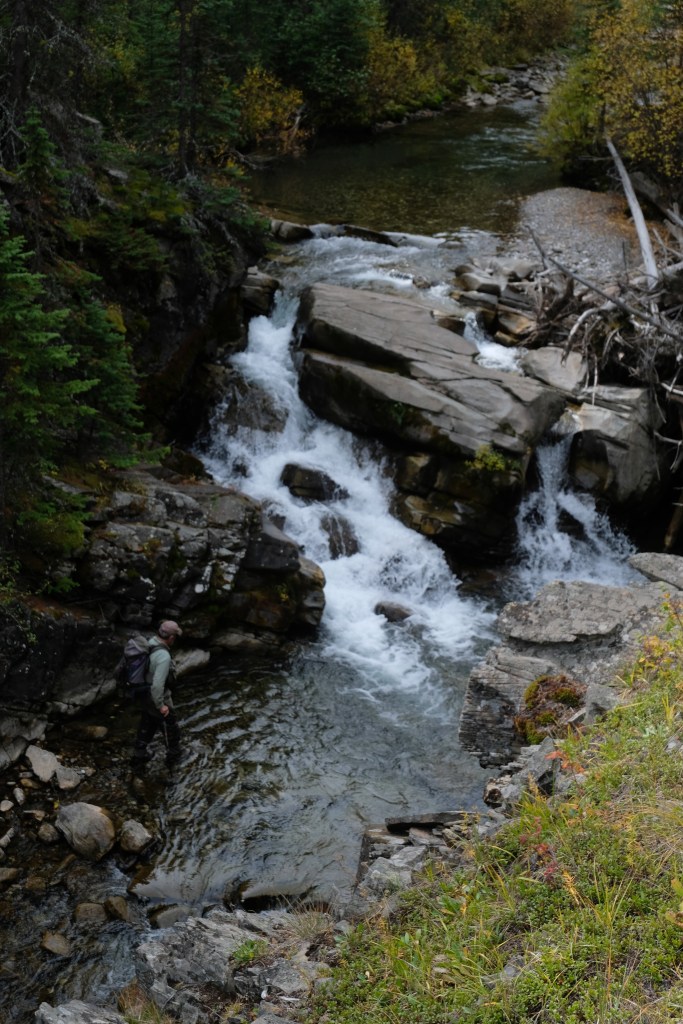
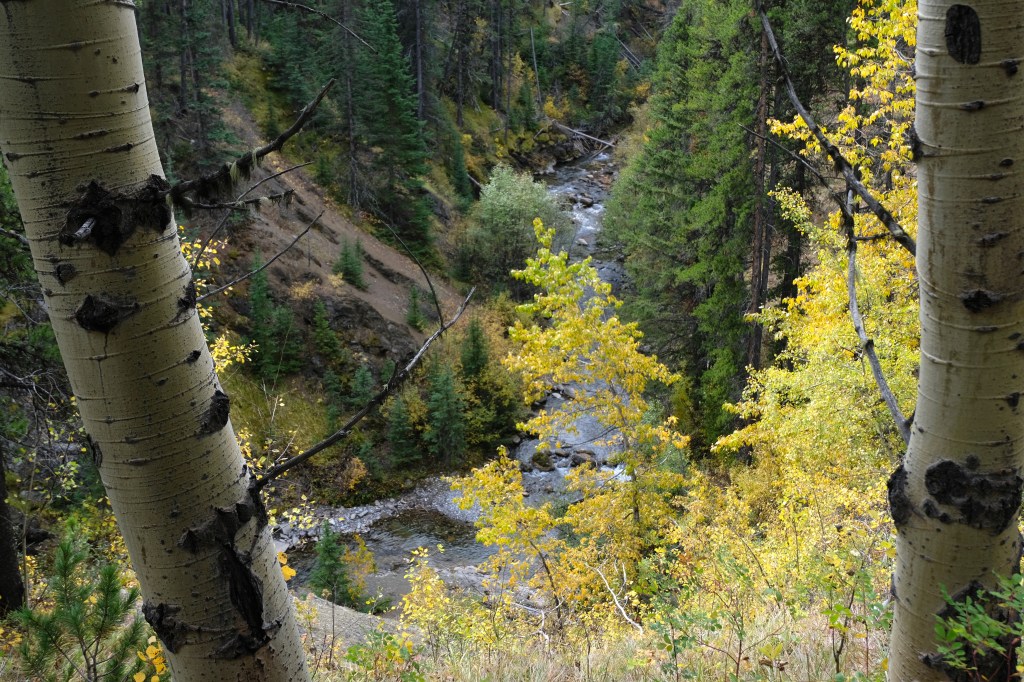
As part of a commitment to recovery of fish species at risk, Parks Canada put a priority on restoration of the nine kilometre section of the Cascade River from  Minnewanka Reservoir to the Bow River in their 2010 Banff Park Management Plan. Only now it is Cascade Creek in deference to the reduced flow.

One has to stand in awe of those who proposed rehabilitating a mostly dry channel, some of it clogged with sediment from the occasional trickle, with essentially all the flow diverted. This was the brainchild of the late Charlie Pacas, a Parks Canada fisheries biologist, who did not have a faint heart when it came to righting a historic wrong. Bill Hunt, as the Head of Resource Conservation (now retired), took up the torch after Charlie’s death.

Sometimes in project implementation nothing succeeds as well as pure, blind luck. In June of 2013, before much work was started an upslope condition resulted in extremely heavy rainfall over a sustained period. Snowmelt was late and the ground was already saturated from several previous days of light rain.  Water levels rose rapidly in Minnewanka Reservoir, to the point the dam structure was at serious risk of being overwhelmed. TransAlta opened up the emergency floodgates, the first time they had been used, creating a flood that raced down the old channel of the Cascade River.

Flood waters blew through several crossings, washing them out and carving a new, wide channel. All the accumulated sediment of over seventy years, over a metre deep, was washed downstream. Yes, infrastructure took a beating, but the flood was also an unintended habitat improvement event, especially for Cascade Creek.

One of the better decisions for project planning and implementation was to retain Dr. Robert Newbury, a “semi-retired” river hydraulics engineer, according to one Parks Canada person. Bob is the Canadian guru for understanding how streams function and what it takes to repair them. He was given a free hand to design and restore the stream—Charlie’s dream.

What Bob was confronted with was a wide ditch in many sections of the stream, with shallow, uniform flow, not good for trout. The task was to integrate natural, high quality habitats into built ones, add riffles, rapids and pools to increase hydraulic complexity, allow the stream to meander and create channel characteristics that suit aquatic insects and trout. Simple, right? 

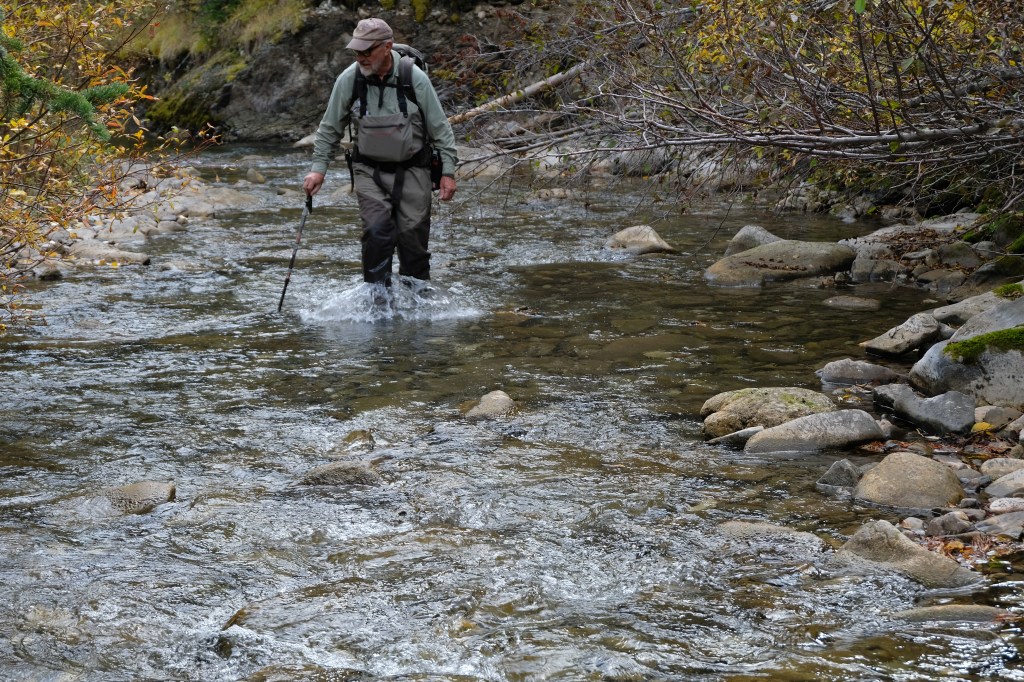
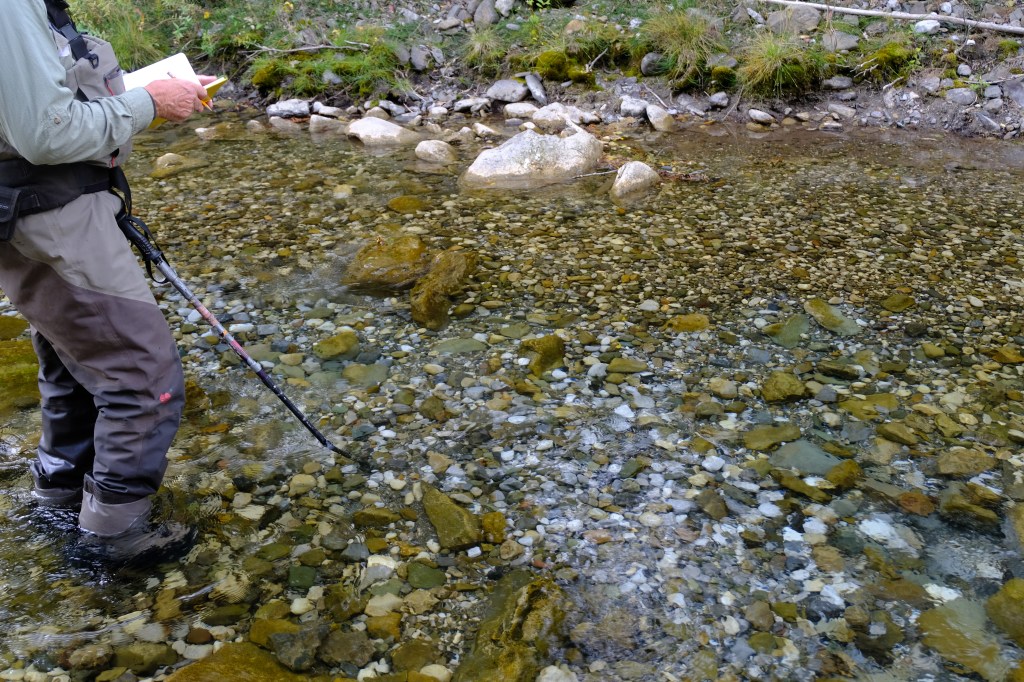
It started with an assessment of the characteristics of the existing channel using cross sectional profiles to assess widths, depths and water velocities at a range of flows. Then it was a question of how closely these characteristics matched the modelled results for the velocity and depth preferences of cutthroat trout and to identify what stream reaches needed a nudge. The geometry and complexity of pool, run and riffle sites (slope, rock sizes, spacing, pool depths, gravels, velocities and discharge) were measured and used to design the Cascade reaches.

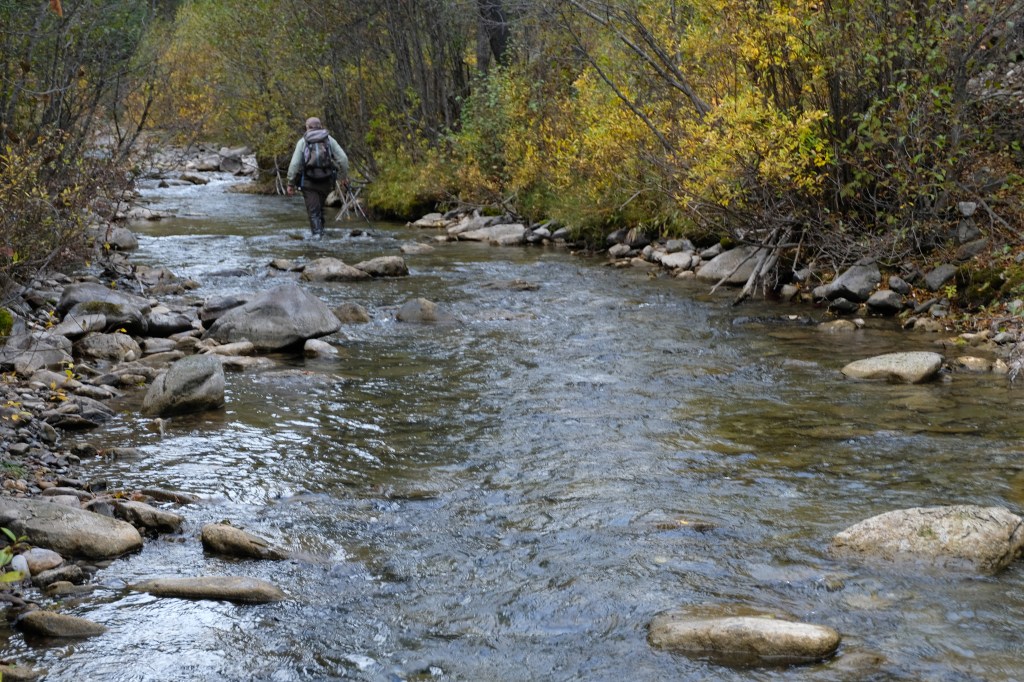
Bob then walked each reach to determine where the existing good habitats were and to see how these could be integrated with built habitats. This is where he pointed out “It becomes a bit of an art, trying to copy a natural stream form in pools, riffles and meander bends.” As a template he had the natural design of a similar trout stream, in the Jumping Pound watershed, as a guide.

To achieve this for Cascade Creek took heavy metal, in the form of a tracked backhoe and a skilled operator, Larry Clark. Volumes of material had to be moved, placed and adjusted, often with the support of Parks maintenance staff. Sometimes it was the careful placement of boulders, just so, with the considerable finesse of a backhoe bucket. Every hundred metres the velocities and depths were plotted, compared with preferred cutthroat trout values and any segments that did not meet these criteria were altered with a combination of pools, riffles and meanders. The physical structure of the stream channel was completed in 2019.

Once the channel was reconfigured hundreds of hours of mostly volunteer time went into replanting the riparian zone with a variety of trees, shrubs, grasses and forbs. As Helen Irwin, who served as the Project Manager, related, “Imagine trying to dig a hole in large stream cobble to plant a willow and you have an impression of the labour involved.” 

Riparian vegetation is the “green” rebar that glues stream banks together, resists erosion, provides a place for sediment to be deposited during high water and is a source of terrestrial insects for trout. The shading from trees and shrubs also helps maintain low water temperatures, essential for trout.

At the mouth of the stream, near the confluence with the Bow River, a fish barrier was built to keep non-native trout species out so they would not compete with native trout. A fundamentally important part of the project has been the willingness of TransAlta to restore and keep water flowing down the new channel.

Work done to rehabilitate the Cascade River and allow native trout to reoccupy the channel after nearly eighty years is a singularly tangible example of species recovery. Although it is still a work in progress the essential elements of a stream ecosystem have been reconstructed. 

The reality is the work is by no means finished and, in such a dam regulated system, will required sustained attention and effort in perpetuity. This is the cost of working with severely modified riverine systems to achieve and maintain a self-sustaining native trout fishery. Monitoring by Mark Taylor, Aquatic Ecologist with Parks Canada, will determine if the trout give it a passing grade. 

No one involved with the project would say it was easy (or will be), but the will and persistence displayed should motivate others to consider similar projects. Charlie Pacas’s “crazy” dream is a reality and others can be as well. This is what it takes to recover native trout populations at appropriate scales. It appeals to me because of the systems approach used by Bob, not a series of band aids. 

Recovery efforts for native trout will only be effective if we can turn back the clock and restore the habitats historically occupied by them. Recreating a Cascade River does just that.

August 2023 

Lorne Fitch is a Professional Biologist, a retired Fish and Wildlife Biologist and a former Adjunct Professor with the University of Calgary.

Hidden Creek: of Bull Trout, Floods and Logging

[Guest column by Lorne Fitch, P. Biol.; offered here as contrast to my telling of the same tale, below]

With an almost magnetic fidelity, bull trout have returned to spawn in Hidden Creek, an Oldman River tributary, probably for thousands of years. Documenting this through redd counts first started in 1995 and went to 1998. Systematic monitoring resumed in 2008 and has continued annually. I have returned, in late September, for years now to find and count bull trout redds. Recently I have waded the stream with some trepidation. 

Hidden Creek used to be the natal epicentre of bull trout spawning for the Oldman River watershed. Logging over the winter of 2012/13 coupled with a major flood in the spring of 2013 dealt the stream, and bull trout, an almost mortal blow.

Prior to the events of logging and a flood, the redd count hovered around fifty-four redds per year with a peak of 108. In 2013 post-flood redd numbers dropped slightly, from the average, to forty-one. From 2014 to 2019 the average dropped to less than ten redds per year, an eighty per cent reduction.

 Bull trout females are the ultimate arbiters of whether a stream possesses the right stuff for spawning. Many must have voted, with their fins, to take a pass on Hidden Creek. Where else they went is a mystery since other streams lack consistent monitoring and are also significantly impacted by logging, roading, motorized recreation and random camping.

Something about the combination of flood and logging created a perfect storm of changes in Hidden Creek, to the detriment of bull trout spawning. Hidden Creek is not gauged, so the magnitude of the 2013 flood and relation to other flood events is unknown.

Even after major floods in 1995 (the largest on record to date in the watershed) and 2005 bull trout still swarmed to Hidden Creek, to take advantage of an abundance of ground water, clean stream gravels and low water temperatures. Following the 1995 flood there was rapid increase in numbers of redds and although redd counts were not done immediately following the 2005 flood, redd counts were very high three years following that event. 

The North Belly River and Blakiston Creek, both in Waterton Lakes National Park, showed a similar rise in spawning success following the 1995 flood. There is no similar pattern for spawning events after the 2005 flood for these streams.

Comparing bull trout redd counts in Hidden Creek, the North Belly River, Blakiston Creek and Falls Creek (Ram River tributary), there seems to be no consistent and negative effect of major floods on spawning activity or on redd counts.

Flood impacts on trout might include factors such as flood timing, flood magnitude, duration of flooding and flood intensity. For fall spawners like bull trout, many of the factors of a spring flood are of a lesser concern except as they affect the  physical elements crucial for spawning success.

A consistent observation from the years following the 2013 flood in Hidden Creek was the lack of suitably-sized gravels for spawning. It was apparent that these smaller gravels had been flushed out of the system, leaving behind only larger rocks and cobble, unsuitable for spawning. Very few of the traditional spawning sites had gravels left and only a limited number of these had evidence of spawning. It appeared that the few spawners left were chasing a limited gravel supply.

Erosion from naturally unstable stream banks coupled with overland flow from logging clearcuts and roads coated the stream substrate with sediment for several years following 2013. Even seven years out from 2013 there was still a sediment supply lingering in pools, where no sediment used to occur. It doesn’t take much sediment to start limiting spawning success—the literature suggests as little as ten per cent over natural background sediment levels has a discernable effect.

Too much sediment likely dissuades a bull trout female from spawning. Even if she does, sediment interferes with the successful incubation of trout eggs laid in the gravels. The interstitial spaces between the gravels are clogged with sediment particles and this can smother the eggs, not allowing an exchange of oxygen-rich water or the removal of metabolic wastes. Trout fry might be unable to extricate themselves from the sediment-impacted gravel.

Bull trout are late bloomers, becoming sexually mature at about age five. If sediment levels inhibit successful reproduction, it sets the stage for fewer trout to mature and return, over time, to their natal stream. Year class failures echo through the entire watershed.

Although there is no discernible effect from flooding on spawning there may be a synergistic one resulting from logging. The effects of logging, especially clearcut harvests, are shown to change the hydrologic response of a watershed.

Removal of the forest canopy, coupled with roads, skid trails and soil compaction from logging quickens the response time of snowmelt and rainfall runoff, sometimes by orders of magnitude. Basically, logging results in more water, delivered more quickly to a stream. This occurs with any level of forest harvest, but more so with large clearcuts.  Flood peaks are elevated, and this intensifies the magnitude of a flood event. This translates into more energy for erosion and more sediment flushed into streams.

Since flows in Hidden Creek are not monitored it is difficult to determine to what degree logging increased natural flood flows. What was evident was the three tributary streams, that flow through cut blocks logged in the winter of 2012/2013, showed substantial new channel incisement, or downcutting. The logging road also intersected all of these streams. 

Upstream of the logged area, three additional tributaries of somewhat equal size were inspected—none showed any evidence of recent channel incisement. This would seem to indicate that runoff from the logged areas was substantially enhanced, over non-logged areas, leading to greater erosion.

Hidden Creek upstream of the logged areas did not have the same accumulations of sediment and it did not appear that gravel loss was as extreme as in downstream reaches. Unfortunately, the upper portion of Hidden Creek is mostly unavailable for spawning because a waterfall is a major obstruction.

It’s troubling that the tributary streams flowing through cut blocks showed only a perfunctory amount of erosion protection. Unlogged buffer zones were minimal, a few metres in width.  Sediment controls, in the form of sediment fences, were either missing, or poorly installed and unmaintained. These were already overwhelmed by large amounts of sediment by the fall of 2013.

Because of concerns over the logging of Hidden Creek, Forest Service staff apparently did regular winter inspections when logging was occurring, but there seemed to be little subsequent follow up to ensure erosion protection was in place and functioning. Self-regulation was ineffective, as was agency oversight.

Conclusions are hard to draw without more empirical evidence, but it seems that logging exacerbated the flood flows of 2013, likely caused a substantial amount of erosion from newly logged cut blocks, and increased the amount of erosion of naturally unstable stream banks. This deposited a substantial amount of sediment in the lower reaches of Hidden Creek and scoured out much of the suitably-sized spawning gravels.

To compound the problem, runoff from an August 2013 rain storm turned Hidden Creek into a muddy soup. Other streams in the area, subject to the same weather event, remained clear indicating that logging had increased the erosion potential substantially in Hidden Creek.

Bull trout spawned in the autumn of 2013, creating forty-one redds. However, it is unknown whether that spawning effort produced new trout. If incubation was successful, that year class, following sexual maturity should have shown up in 2018 and 2019. But they didn’t. Subsequent to 2013, redds counts dropped alarmingly, down to one redd in 2019.

Redd counts in 2020 showed thirty-four redds, somewhat of a resurgence, but dropped to nineteen in 2022 and to fifteen in 2023. This is far from the long-term average. It shows the effects of logging can linger and a landscape can hum like an anvil long after the hammer of development has hit.

Signs of recovery occurred after six years. This is likely related to flushing of sediments from gravel by subsequent high flow events and the recruitment of new gravels with normal bedload movement. It is easy to leap to a conclusion based on one year of higher redd counts but continued monitoring shows the positive trend has not continued.

One winter of logging has equated to at least six and probably ten years of lost bull trout spawning and population recruitment for much of the Oldman watershed. For a species that is designated as Threatened, this is a near mortal blow. It begs an essential question—can sensitive watersheds essential to the survival of trout species at risk be logged without serious impacts to those populations?

Whatever the Forest Service and the forest sector say, Hidden Creek provides an unequivocal answer.

September 2023

Lorne Fitch is a Professional Biologist, a retired Fish and Wildlife Biologist and a former Adjunct Professor with the University of Calgary

Hope Renewed

Lorne Fitch has been keeping his finger on the pulse of the Oldman River for over seventeen years.  He doesn’t check water levels or water temperatures, even though he is acutely aware of them.  Instead, he keeps track of the bull trout.

Bull trout are Alberta’s provincial fish – a wise choice, given that they largely evolved here and their migratory lifestyle ties together entire river systems.  Some bull trout live year round in mountain streams, never growing much larger than a frying pan. Over the years, too many of those ended up in frying pans, unfortunately; one reason the species is now classified as threatened.

But a lot of young bull trout migrate downstream to big prairie rivers where the food is abundant.  There they grow into meter-long giants that lurk in the bottom of pools and prey on other fish.  As water levels decline in summer, they begin to work their way upstream until they arrive in the small mountain streams where they were born. There the big females scoop out trenches in the gravel at the tails of long pools, creating nests called redds where they discharge their eggs while smaller males crowd close and release milt to fertilize them.  The eggs become buried in the gravel and survive there because well-oxygenated water constantly percolates up from below and washes away silt and algae that might otherwise suffocate the eggs or fry.

You don’t get clean gravel stream beds in abused landscapes.  Where aggressive industrial logging operations strip away ground cover and expose raw soil to the elements, runoff brings so much eroded dirt that it overwhelms the ability of small creeks to flush it away.  Although the largest spawners can bury their eggs in gravel large enough to resist heavy stream flows, the big dirty floods that drain over-logged, over-roaded or over-grazed land can blow those spawning redds out.  Coal strip mines, gravel extraction and motorized recreation all have the potential to ruin a stream for bull trout.  And we’ve got all of those things now, in places where bull trout used to thrive. Where streams used to be healthy.  Because the land was healthy.

Hidden Creek is a tributary of the Oldman that lives up to its name. There are no permanent roads in its drainage.  To get there, one must wade across the upper Oldman and hike up a side valley where the only sounds are water, wind and birds.  It’s always been a critical spawning stream for bull trout because of its clean gravel bed and abundant groundwater that saturates the surrounding slopes and wells up into the stream bed at frequent intervals.

The best year Lorne has recorded on Hidden Creek, he and his colleagues found more than 100 bull trout redds.  Over most of the years the average was about fifty.  But things changed ten years ago.  Spray Lakes Sawmills carved an access road up the valley and clearcut several large patches of timber on the valley slope.  The loggers had barely finished backing out of the valley when the 2013 flood event hit the Eastern Slopes.  Massive runoff from those clearcuts magnified what was already a huge flow and the creek blew out several sidehills while flushing much of that good gravel downstream, scouring out the best spawning reaches.

Bull trout nearly vanished.  The lowest count of redds in recent years was one.  One single female bull trout managed to find a place to deposit her eggs.  That one bull trout was a living measure of the loss of watershed health, because bull trout can only thrive in healthy watersheds. That’s why the species is already gone from other nearby streams — they got hurt harder, and sooner, than Hidden Creek.  Now, it appeared, even Hidden Creek had become another failure.

This September Lorne invited me to join him on his annual bull trout spawning survey.  With Cheryl Bradley and Gail we waded the Oldman, picked our way through a replanted clearcut, and rendezvoused with the creek a kilometre or so above its confluence with the Oldman.  While Cheryl and Gail continued up the trail to explore the valley, Lorne and I put on our chest waders and stepped into the creek to begin a long upstream transect.

Not a redd to be seen, at first. There wasn’t much in the way of promising-looking spawning gravel either; ten years after the 2013 flood the stream still hasn’t been able to replace much of what washed away.  Here and there we saw red survey ribbons on stream side branches marking where previous years’ survey crews had found redds, but the stream bottom was cobbly and empty.  At one promising-looking spot where he had almost always found redds before Lorne stared at the water for a long time before turning to continue upstream, muttering, “I don’t know. I just don’t know…”  I could hear in his voice what I could feel in my sinking heart.

But finally, after a kilometre of hiking we found a redd at the tail of a deep pool.  The gravel was clean and devoid of algae or silt, partly mounded and partly hollowed out, showing where a big bull trout had scooped it out and then refilled it as she moved slowly upstream, releasing eggs. She must have been big; it was surprising to see the size of some of the stones she’d moved.  “That’s why the really big females are so important,” Lorne explained. “They’re the ones that can get their eggs deep enough in material that can withstand the spring runoff flows.”

As canyon walls began to rise on either side of us, it became an increasingly good day.  By the time we met our companions for lunch at an impassable cascade, Lorne had counted fifteen redds.  That’s well down from the average count before the logging equipment arrived in the valley to destabilize the landscape, but also well up from the lowest counts after the big 2013 flood event.

We didn’t see any bull trout, just the occasional cutthroat and a couple of sizeable schools of mountain whitefish.  Those smaller fish stay in the creek all year round, but the bull trout had evidently retired downstream to the deeper pools where they spend the winter.

Native trout like the bull trout aren’t just a thing for anglers. Their relationship with the Eastern Slopes and the streams that are born there goes back deep in time, far deeper than even than the oldest Indigenous culture. Our modern interest in catching them, or just watching them, has no meaning to them.  They live in their own ancient reality, intimately tied to the patterns and processes of their part of a living green planet.  They are who they are.  It was a privilege to visit their home place, irrelevant though we might be to them.

For all their intrinsic value, though, bull trout are also a measure of our success, or failure, at living here well.  We have the capacity to destroy them simply because of our hunger for stuff and the technological prowess with which we pursue that hunger.  We don’t need to catch and release the big female bull trout that are so essential to the success of the population.  We don’t need to practice the kind of industrial-scale forestry that destabilizes whole watersheds and disrupts groundwater recharge so dramatically.  We certainly don’t need to extract coal from those headwater drainages.  We can use land lightly, instead of leaving it tracked up and compacted with wheels. If we get things right, bull trout will persist. If we don’t, they won’t.

Lorne and I talked about the good things we remember from our childhood, when bull trout were still abundant and the Eastern Slopes a paradise for those of us lucky enough to grow up there.  We are both writers and we put a lot of words around our solastalgia and regret.  It used to be that that sort of prose motivated conservation action because those who read it still believed in the future and could be fired up by indignation and anger.

Now, however, we seem to live in an era of worry and despair.  People don’t want to be reminded of what they have lost because it simply deepens their gloom and heightens their feelings of powerlessness.  Reminding people of the good old days doesn’t motivate; it paralyzes. That’s one reason I hesitated before sitting down to write this piece.

But there is this: today we found fifteen spawning redds of a fish that had almost vanished from Hidden Creek just a few years ago.  Where off-road vehicle traffic and irresponsible logging had damaged the creek banks, even way up the valley, we found willow thickets that had been planted by volunteers who hiked in and worked hard to give the creek its health back.  There were no tire tracks to be seen. The logged areas are damaged, but regrowing.  And there will be no coal mines in that valley. People mobilized to make sure of that.

There were grizzly tracks on the trail.  The breeze was sweet and clean, and the aspens glowed golden with hope.  It was a very good day.

The mess we are in today is the product of the past — of choices we made and the things we did before now.  We had the best of all chances and we squandered it.  Lorne and I are right to regret what we remember because the past we remember is over. It’s not coming back.

But what will come next need not necessarily be less. Those fresh trout redds spoke to us not just of the meaning of this place but of second chances. The future could even be better than what we remember; it depends on the choices we make and the things we do today and tomorrow.  We can make good choices.  We can make sure that others don’t make bad ones. We just have to care enough, try enough and dream enough. And it’s already happening.

The bull trout are still there, waiting to let us know we got it right. Imagine one hundred huge bull trout spawning in a green and intact valley whose waters flow clear and sweet to communities whose people choose to live in a good way with a place they love and respect. Hope is imagination, acted upon.

I came back from Hidden Creek tired, sore and old, but I also came back with hope renewed. We haven’t left our best possibilities behind us; we create new ones daily.  Next year those giant trout will reappear like the annual miracle that they are, nosing their way upstream from pool to pool until they sense the sweet, cold water rising up through clean gravel. They will hang there, fins slowly moving in the current, like so many generations of bull trout have done before, on the verge of that annual spawning ecstasy when they release the promise of new life into a living stream that drains a land fairly pulsing with life and meaning. Still. 

Our very best nature could actually lie ahead of us. We cannot change the past, but our choices will shape the future.  Hidden Creek reminded me, yesterday, that imagination can be as rich as memory, and that nature can be patient. It can take us somewhere better than where we are, than where we’ve been.

If we choose.

Weathering Anxiety and Grief

[guest column. Lorne’s long-anticipated book Streams of Consequence will be released in fall 2023 by Rocky Mountain Books. More info: https://rmbooks.com/book/streams-of-consequence/ ]

Lorne Fitch, P. Biol.

Against white cumulus clouds roiling in a slow boil, a redtail hawk soared on a rising wind. Never once flapping its wings, but dipping and weaving with the gusty winds it tacked forward. A weather front, with inky blue/black clouds rolled in ˚˚from the north on a chilly wind. The plus 30˚  C air was shoved aside, to my relief. I could both feel and taste the cooler air of the front as it passed over the cabin. A sudden drop in temperature and the quality of the air seemed fresher, energized. The hawk, inexplicably pursued by a flock of waxwings, disappeared into the gloom of the approaching front.

From sweating to shivering in minutes, like a fridge door opening. Under a roof the spectacle is partly pure entertainment. But with the drought-parched grass, tinder dry, waiting for some casually tossed cigarette butt, a hot exhaust from an off-highway vehicle or a lightning stab, there is also a palpable sense of anxiety.

To hell with BBQs, town parades and golf games—let it rain, rain hard, rain long, soak the earth. Except, with the wind is a little fragment of ash, from nowhere close I hope. Probably lofted on  the winds from fires in BC. Anxiety escalates—climate or eco-anxiety. The American Psychological Association has defined this as “a chronic fear of environmental doom.”

The weather system huffed and puffed, sending chairs flying.  Dark clouds, so full of promise, delivered a few sprinkles. This hardly registered in the dust. It’s enough to persuade you to wash the car, hang out clothes on the line or take a hike without your rain coat. Anything to tempt the rain gods.

But I think, if it rains too hard, forests ravaged by clearcut logging can’t hold the rain. Then somebody’s basement is going to get wet, or a bridge will get washed out. Receiving streams and rivers can’t hold it all. Stream banks get eroded, the channels widen and when water levels go down, they go way down so the water is shallow. Then the water warms up too quickly and native trout suffer. Trout have suffered enough, so much so they are missing in many of their old haunts. This makes me sad.

What makes me even sadder is we can’t seem to come to grips with connecting the dots, especially limits. The ever expanding footprint of logging, of roads and off-highway vehicle trails that dissect the landscape, of cultivation of native grassland, of draining our rivers for irrigation, of oil and gas extraction, and of urban sprawl. I could go on but this puts me on the edge of either crying or raging. The rampant greed, thoughtlessness, destruction and inability to think ahead for other generations mystifies, frustrates and angers me. 

It seems the places most in peril are the ones of great natural beauty, biodiversity havens and ones ecologically intact. Once we put them through the development shredder they are rendered barely recognizable, like an old friend ravaged by disease.

Because I am old enough to remember intact places and have listened to those older than me wax on about fish and game abundance I can see the extent of changes, of losses, of damage. Acid drips on my soul. Even when I find out there is a name for this feeling of homesickness for something that no longer exists—solastalgia—it doesn’t modify my eco-grief. It does help that others have experienced this deep feeling of grief for our landscapes, plants and wildlife.

Routinely, when destructive development threatens an intact landscape, we ask for the rationale and press for environmental impact assessments. To further prevent these losses we have lobbied for better land use planning, cumulative effects assessments, the setting of ecological thresholds and timely, progressive reclamation standards. But we end up fighting rear guard actions, over and over. It’s draining and it adds to the sense the cards are stacked against a reasonable, rational, ecological approach.

The Mental Health Commission of Canada summarizes these feelings with, “The natural environment is changing, and people are worried about what it means for the future. That worry, which is increasingly becoming severe enough to cause distress and dysfunction.”

Even though 75 per cent of people living in Canada consider climate change a global emergency there is a combination of denial (most notably among some federal and provincial politicians) and the fatalistic thought it’s too late to do anything about it. The problem with deniers and their kin in the corporate and political world is summarized in Dornbusch’s Law, which states, “Crises take longer to arrive than can be imagined, but when they do come, they happen faster than possibly can be imagined.” How many “wake up” calls do we need?

I know I harbour anger and a level of frustration toward governments that have not done enough (or anything) to curb the tsunami of climate change, manifested in catastrophic wildfires, floods and drought. Equally so I feel the anger directed at older generations, like mine, for misusing the time and influence to alter the trajectory we are now on.

This also leads me to a combination of guilt and further anger over our individual carbon footprints. Our economy, our policies, advertising and perhaps our psyches are geared to consumption. This exceeds the Earth’s ability to supply the raw materials and deal with the environmental costs of production, transportation and waste disposal. We desperately need some full cost accounting to show us a possible way out of this overextension of the global natural bank account.

Alan Moore, in the Watchmen, said in what could be a response to eco-anxiety, “In an era of stress and anxiety, when the present seems unstable and the future unlikely, the natural response is to retreat and withdraw from reality, taking recourse either in fantasies of the future or in modified visions of a half-imagined past.” Sound familiar, in observations of how some react?

Short of some kind of technological and unlikely miracle, there isn’t a quick cure for our environmental muddle, especially the climate change one. While it’s true the corporate and political world have a lot to be answerable for, that tends to absolve us as individuals of responsibility. Each of us has to acknowledge a level of responsibility and step up to the plate with solutions within our sphere.

I acknowledge my role in our environmental pickle. Yes, I live in a house made of wood, drive an internal combustion engine car and eat bananas flown in from Ecuador. That is a first step for all of us to take. I rely on acknowledged experts to inform my thinking on topics of an environmental nature and then use my writing to inform others. Without reliance on science and critical thinking it is easy to fall down the rabbit holes of conspiracy theorists, denialists, false experts, misinformation and distortion.

Part of our angst is we have little control over most external circumstances. We can choose how to respond though. Each of us can take actions and have control of some aspect that can reduce eco-anxiety, maybe even grief. In Sing You Home, author Jodi Picoult writes, “Anxiety’s like a rocking chair. It gives you something to do, but it doesn’t get you very far.” 

If we have investments we have the choice of where to invest, refusing to put our money into things that continue to pollute, eat up our landscape and exacerbate climate change. We can live more simply and sustainably by resisting the urge (and advertising) to be bigger consumers. Since the energy cost of transporting food far outweighs the energy in it, we can eat closer to home, by patronizing local food growers, especially the ones involved in regenerative agriculture. When we vote we should think several generations ahead, not what fills our pockets today.

When I think of growing up in the 1950s and 60s, we didn’t have much, didn’t seem to miss it and I don’t think I was emotionally scarred by not having the latest toy or nice clothing or exotic travel. I’m reminded of the tongue in cheek statement that, “No one is going to stand up at your funeral and say, ‘he drove a really nice car and had expensive golf clubs.’ Don’t make life about stuff.”

I strive to reduce my footprint, albeit sometimes unsuccessfully. Changing our lifestyles and overly consumptive habits isn’t about perfection but being aware of not only the price sticker, but also the environmental cost of our activities and purchases. Then it’s working towards a goal of reducing our footprint as well as feelings of guilt and anxiety about our future. Collectively that can make a difference. Then the only thing left is to pressure government and the corporate world to do their part.

August 2023 

Lorne Fitch is a Professional Biologist, a retired Fish and Wildlife Biologist and a former Adjunct Professor with the University of Calgary.

Disputed Terrain

July 9 2023

The river is in ongoing negotiation with the land over who owns that edge where willows crowd down to the cobbles and poplars lean back into the sun. They even dispute ownership of the cliffs along the outside bends. It’s a conversation that goes on season after season and nothing is every fully resolved.

During the spring spate, the river makes its most forceful and compelling case. It breaks off bits of cliff and takes possession of the cottonwood groves. But it can’t sustain such passion, and the flows slack off, and the land quietly asserts its ownership; cobbly islands emerge and new poplars sprout on them. Winter brings a truce but then it’s spring and the whole conversation picks up where it left off.

This being summer, the river was too warm for fishing today but that meant it was just right for sitting in it and contemplating the life that goes on along that contested riparian edge. Something good was evidently hatching out of the river, because three trout were rising in the slick run just upstream from my seat. Two little splashers and a seriously large fish that pushed up a big bulge of river each time it rose. A kingbird liked the looks of that hatch too, because it dove from the Douglas fir three times and, osprey-like, splashed the surface as it picked off floating mayflies. Then it was gone; back from the river edge and up to its nest in our windbreak.

That left the cedar waxwings. They weren’t willing to take the same risks as the kingbird, choosing instead to take turns fluttering out into open sky, grabbing an insect in midair, and returning to their perches on a half-dead fir that leans out from the edge of a cliff. It won’t last many seasons more before it falls victim to one of the river’s more convincing arguments and becomes flotsam.

The waxwings seem to like company; they feed in twos and threes, taking turns darting out. Once two waxwings went out after the same insect, realized what they had done, and both politely turned away, leaving the fortunate survivor to sail away in the sullen warm breeze wafting down the valley. Perhaps safe, perhaps not; overhead the violet-green, rough-winged and tree swallows were on constant patrol for insect life lifting into the sky from the river.

Two spotted sandpipers came shimmering down the river and veered suddenly at the unexpected sight of the bemused human sitting in the middle of a riffle. They landed in the pale cobbles, teetering, peeping, scurrying in and out of the willow fringe as they fed their way downstream on that contested terrain. They have fluffy little babies somewhere on that mid-stream island but much as I like to see them I tend to leave them undisturbed. They and their river have their own matters to attend to.

The riparian fringe is wider now as the river recedes to its summer low flow. Mint is starting to bloom. There are peeled willow stems half-in, half-out of the current edge, and beaver trails up into the thickets. Most of the life I see along the river edge is diurnal because that’s when I’m there, but the tracks in the sandbars and mud deposits are evidence that it continues through the night. Mink, sometimes raccoon, sandpiper, deer, bears. They all have reasons for bearing witness to those negotiations between water and land. Mostly involving food, because it’s a fertile place, and always wet.

One day I put a trail camera on a gravel bar, leaning against a willow, and later retrieved dozens of photos of robins who evidently spend more time under the river willows than I had imagined. And a northern waterthrush. Who knew? The river and the land knew, of course. It’s always been part of their conversation.

Another time I saw an otter. Exotic to me; well-known to the river and presented by it as evidence of why that contested strip should be considered river property. The land replies with deer and skunks.

The issue remains unsettled, and probably always will; an entirely satisfactory situation for all other interested parties.

Working Landscapes [from Wild Roses Are Worth It]

Talk to anybody employed in forestry and you’ll likely hear the term “working forest.” That’s where feller-bunchers and chainsaws convert living forests into trucks loaded with logs – most of northern and western Alberta, in other words.

Global Rangelands, an outreach initiative sponsored by colleges and universities in the western US, extends the concept to everywhere else: “When we talk about working landscapes we are talking about the areas between cities or towns and natural areas with limited continuous use by people. Rural areas, which often are dominated by intensive or extensive agricultural, forestry or other natural resources–based economies, are generally a part of a working landscape.”

The working landscape is a concept that appeals to our materialistic culture. Why let things go to waste if they can be put to work generating profit? “Deep ecologists”who see humans as just one of many equal components of nature – may scoff at the idea, but more pragmatic environmentalists seem comfortable enough with it. The late Francis Gardner, a respected foothills conservationist and rancher, once described his family’s ranch to me as a “working wilderness.” He and his wife Bonnie saw their role as stewards of an intact ecosystem, and the wolves and grizzly bears living there as indicators – albeit challenging ones – of their success.

Advocates of the working landscapes concept argue that we can make productive economic use of the land while still retaining its biodiversity and ecological functions. That’s an attractive ideal, and one worth working toward. The results, unfortunately, sometimes fail to match the rhetoric.

Just as a working person is better than an idle one, and working parents often get more respect than those who stay home to raise their kids, the idea of a working landscape attaches economic and cultural worth to a landscape that many would otherwise see just as idle scenery. But it’s predicated on a value system based on domination and subjugation. The darker side to the “working” metaphor, when applied to living places, is that it assumes a moral right of corporate interests to colonize and repurpose whole ecosystems. If it’s a working landscape, then by implication the logging companies, oil and gas industry and livestock producers who put it to work should get to decide what happens there. Others – especially Indigenous people, environmentalists and recreationists who might like it the way it is – should butt out, or at least be grateful when the dominant class grants them the chance to offer humble suggestions.

Another dark side of the working landscape concept is that it’s founded on the conceit that leaving land alone is somehow wasteful. Corporate interests and their political protectors, for example, often describe establishing parks as “sterilizing” the land – a deliberately hostile verb. In truth, land is only truly sterilized when buried under roads and asphalt, or cropped so hard its soils can only be kept fertile with chemicals. Sadly, our working landscapes include a lot of that kind of land.

None of those working landscapes ever applied for the job. But in a society that accrues material wealth by exploiting natural resources, land is simply forced to do work we’ve assigned it. The same business interests who are so enamoured of “working landscape” also love the term “multiple use” and often mention both in the same breath. We expect land to do several jobs at once: produce wood for mills, surrender oil and gas to be burned, feed cows and be mined for its gravel, coal and other subterranean assets. So these aren’t just working landscapes – they’re multi-tasking ones, toiling away at tasks they never signed up for.

When a human being is given no choice but to work at a job he or she never asked for, that’s called slavery. 

By that definition, there are no working landscapes, only enslaved ones. The only free landscapes would be our parks and protected areas and the remaining bits of the rest of the province that haven’t yet been indentured to one or more resource companies. Far from having been sterilized, protected areas are places where land is allowed to do its real work.

Because every one of those landscapes was already hard at work. They work at capturing rain and snow and filtering it through green vegetation and spongy soils into groundwater aquifers that feed springs, rivers and downstream communities. They grow diverse plant communities that pull carbon dioxide from the air and put oxygen back in. They work tirelessly at providing habitat for native plants, animals and fish, and spiritual renewal for many thousands of people. They hold memory, meaning and life.

Alberta’s enslaved landscapes were never unemployed to start with. And most of the jobs we force them to do impair their ability to do their real work. That’s how slavery works; it makes bosses rich by stealing the energies of their slaves.

Good Anger

Coal was the final straw.

I grew up in a fishing and hunting family. We spent golden days in the foothills of the Rocky Mountains, from the Oldman north to the tributaries of the North Saskatchewan. Rolling, pine-clad hills, quiet trout streams, chance sightings of deer and bears — it was paradise for a kid.  In the fall Dad took us hunting pheasants on the farms of relatives east of Strathmore. In between times, impatient, I sought out the wildest places I could find and became a birder.

That was many years, and many governments, ago.  Mostly conservative governments: some good, mostly bad.  Certainly Peter Lougheed’s government was one of the good ones.  It gave us an Environmental Conservation Authority, strong environmental laws, Kananaskis Country and a Coal Policy.  Especially in the early years, Lougheed’s vision of environmentally-responsible development seemed to offer Alberta a future where nature and commerce might flourish together.

But it didn’t last.  The ECA got disbanded, regulatory agencies were de-fanged and greed took over.  It seemed like each election resulted in the “progressive” part of Progressive Conservative fading more, until it vanished altogether and we got a new creature: a “United Conservative Party.”  The centre shifted and “progressive” came to define opposition parties, not government.

What did that look like on the land?  It looked like paradise lost. 

There’s a uniquely profound sorrow that comes of having one’s identity shredded. I chose a career in biology because I’d grown to love everything natural about Alberta.  But the creeks, far valleys, shrubby corners and coulees that grew to define me were under siege from a careless capitalism that, as Oscar Wilde said, knew the price of everything but the value of nothing. By the time I retired, life had become a constant battle against what philosophers call solastalgia – the profound homesickness one gets when home is no longer there.

Native trout are gone from many of those childhood streams. Once-peaceful foothills valleys are tracked up by motor vehicles and filled with noise all summer long. Once-green woodlands are mangy with clearcuts. Prairie grassland is upside down and silent. Even the barn swallows are gone.

It happened incrementally, the consequence of inattention: Albertans’ casual assumption that home would always be there, no matter how much the governments we elected commodified it and it off in bits.

But love doesn’t offer one the option of giving up, even when one’s heart is breaking. When an angry province surprised itself by electing an NDP government in 2015, I was one of many who felt hope rekindle. Here was a government, like the original Lougheed one, that actually believed in the public interest. After three decades of promises but no action, the new government actually established new parks in the Castle River region.  Then they went on to planning for the public lands in the rest of the Oldman drainage. Recently retired, I volunteered on advisory groups working on both those initiatives. It seemed impossible, but we again had a government committed to stewardship of our best places and values.

Many of my fondest memories of wild Alberta reside in the green foothills west of Rocky Mountain House, and it’s there that the NDP government proposed to establish a Bighorn Country similar to the Kananaskis.  But that, apparently, was one conservation hill too far for the angry few who had grown accustomed to laissez-faire mis-management of public lands. In the 2019 election campaign, UCP politicians like Jason Nixon drew on that anger, magnifying it with lies, and rode it into power.

And so, in the 2019 election the NDP were swept aside and replaced by the UCP.  This was no progressive conservative party.  It wasn’t even truly conservative.  It was a reactionary party of hard-core commodifiers.  Everything was for sale.  Nothing was sacred. The public interest would be determined in the marketplace, not by policy.  

Those motivated by love of place and care for wild nature felt crushing despair as the last rules were shredded, parks put up for sale, resource protection staff isolated, and public concern sneeringly dismissed as “NDP talking points.” We’d tasted hope, and had it swept away.

And then came coal.

Since 1993 when Gail and I moved our family to Waterton, I had worked with dozens of good, decent people who loved the land in much the same way as we do.  Ranchers, farmers, Blackfoot and Stoney people, business owners, artists…they came together in various combinations to manage carnivore conflicts, restore trout streams, steer industrial development away from sensitive habitats and just generally try and keep good places good.

In 2020 we all woke up to the news that the UCP government had secretly cancelled Peter Lougheed’s Coal Policy and handed out massive leases to foreign coal companies. The entire headwaters region of Alberta — almost every inch of that childhood paradise that gave shape and meaning to mine and so many other Alberta lives — was being offered up cheap for strip mines.

That betrayal was the last straw, not just for me but for all those good people with whom I’d been so honoured to work over the years.

The worst kind of anger is motivated by hate and selfishness.  But there is a good kind of anger – that motivated by love. And it was love of Alberta that united so many people to fight the sellout of our headwaters to coal companies.  Few things have inspired me so much as seeing Albertans of every type come together to force a rogue government to step back from their plans to pillage our headwaters. The massive resistance to coal strip mining renewed my hope that we might finally be uniting into what Wallace Stegner dreamed of: “a society to match its scenery.”

Alberta has arrived at a crossroads.  It seems like everything good about this place is under threat.  Yet it also seems like we could be awakening to ourselves as a people who will fight for what we love.  Coal, in that regard, was a good thing; it woke us all up. But there is still a risk that we’ll get distracted and look away from the things we matter most.

So I ruined a perfectly good retirement and went into politics.  

I had to: it would be a betrayal of my very identity not to defend the good places, wildlife, people and enduring values of my home place. The UCP has taken us to the brink, but at least where the coal fiasco is concerned, Albertans have pulled back.  Now we need to restore what we can of our lost nature, and ourselves. We need to put our good anger to work – making the best of what remains, and what could yet be.

Solastalgia will have to wait; I’m running for office in hopes of being part of a government that builds forward from the last, desperate hope we’ve all found — for love of our home place, one another, and all our relations.

Hermit Song

Perhaps it’s just natural that a lifelong loner should have an affinity to hermit thrushes. We share a common habitat, after all — that of solitude. But that’s too facile an explanation; my love for these birds is more nuanced than that. Whatever the case, when I arrived in the timberline forest near the head of a subalpine basin the other day and stopped to listen again to the wistful beauty of a hermit thrush singing somewhere back in the dim, it evoked a host of memories and associations.

For those who aren’t loners, it might seem that loneliness would be a stranger to those of us who prefer our own company. Not really. In the late 1970s I landed what seemed the perfect job for one who likes himself better when hanging out with wild things in wild places than with others of his own species. That work — conducting inventories of wildlife populations — took me into the remote corners of Canada’s Jasper National Park where I worked alone, often for days on end. More often than not, when I climbed out of my tent or stepped out of a patrol cabin into the pre-dawn shadows to begin another day of field work, there would be a hermit thrush singing somewhere in the cool secret places beneath the trees. And late in the evening, as mystery spilled down from the peaks to darken the world, again there would be a hermit thrush, intoning its wistful benedictions into a stillness we shared.

The slow, ethereal flutings back in the woods seemed to speak of their own kind of loneliness, of nostalgic loss and poignant rememberings. I’m sure those birds sang for themselves but it was a language I felt I almost understood as I simultaneously savoured my solitude and ached with loneliness. Strange days.

Years earlier, when I was religiously memorizing the first bird book I ever bought — the first edition of Birds of Alberta, by Salt and Wilk — I had been taken by the authors’ description of the hermit thrush’s song: “Oh, heavenly heavenly…ah, holy holy…” I had yet to see my first thrush, but I was haunted never-the-less. Maybe it was those lyrics that first made me equate a shy, brown bird with the parable of human exile from Eden.

Years later, when I was discovering the timberline trails of the Canadian Rockies, I sometimes backpacked with a book to read while resting. Tolkien’s Lord of the Rings trilogy was a particularly favoured companion; when the larches turned gold or the meadows were brilliant with blooming glacier lilies it was easy to imagine that I was in Middle Earth. In fact, I was — because the tragedy of Middle Earth was the loss of magic from the world of men – but I was discovering places where it lingers on. Jackson Browne sang of an earth wounded by “men who tried to forge her beauty into power” and that, to me, was the metaphor that linked the Christian story of the Fall to Tolkien’s fantasy novel: the deep human flaw that makes us all lonely strangers in a world of relations to whom we no longer relate. Magic dies when one ceases to look at the living world with wonder and love, striving to hear its music and to understand how best to relate to the beings with whom we share our existence, and instead simply focus on their utility and how we might possess and use them.

What good is a hermit thrush? Wrong question.

In the story of the Fall, humans eat fruit from the tree of knowledge reserved only for God. But it’s not the knowledge that banishes Homo sapiens from Eden; it’s our reason for wanting that knowledge and the fact that it turns everything else into a mere object of analysis. We objectify the world to gain power over it and, in so doing, isolate ourselves from wonder, humility, and relationship. We make loners of ourselves, and wind up alone, on the wrong side of the gate that locked behind us when we stepped through it. To understand the parable of the Fall, the first thing is to know that it didn’t happen once upon a time; it happens every time we look at the world merely as a bundle of resources, rather than a living source of wonder and inspiration.

In Tolkien’s trilogy the elves are the ones who love song and mystery, and live in a world infused by magic. “A Elbereth Gilthoniel!” they sing in celebration of a time when all was magic. 

But at the end, they sail away into the West, taking their magic with them and leaving the world to men. It’s the same story, really.

But the magic never really left; we simply turned away from it. It lives on in an Eden from which we never departed, except in our spirits. It lives in newborn creeks that bubble out of flower-strewn meadows and tumble through forests of larch and fir; it lives among the peaks, especially when they are wrapped in storm clouds or caught in the last rays of the sun; it is in the woods, the fens, the wind, and the wild things. There’s a dark magic in the eyes of a grizzly bear when it stands to study a startled hiker, and a bright magic in the way warblers flicker through the willows. Mayflies dance in magic sunbeams. When life emerges out of winter’s icy stillness, that’s magic. When trees crack with the cold and ravens hunch themselves against the hard winter wind, that’s magic too. It’s everywhere; it’s just hard to see it through the eyes of exiles.

I wonder if hermit thrushes remember the elves, or know them still. I suspect that they are actually birds of Eden, and that the half-light in which they prefer to sing is that place that lies between the lonely, lost world of humankind and the magic from which we turned away. Perhaps, if Tolkien’s elves sailed away into the West and left only the memory of magic behind, they also left a humble brown bird to keep that memory alive in sweet, forlorn laments that make mountain shadows sacred.

If we believe that magic has truly left this world, than a hermit thrush’s achingly sweet, spiraling song might be heard as the music that arises from memories of memories of mystery.  But I think it is more than that; it is proof, in itself that magic never left our world at all; we simply looked away.  Back in the sweet, subalpine shadows of forests, those small brown birds lament our loss of wonder even while they invite us back into its embrace. 

I’ve come to the certain belief that there is no time better spent than that spent listening to the hermit thrushes who sing to us from the edge of Eden, reminding us to remember what most of us don’t even realize we’ve forgotten: “A Elbereth Gilthoniel: Heavenly… heavenly… holy…. humbly… home.”

Toad’s Legacy

from Our Place/A Natural History of Home

(original version dated 1998)

“. . . On the river, when you are

finally on the river and you are alone with a friend,

you can finally

let it go, all the rancour and the displacement

it does not matter here. They say I am a newcomer

and I say to them

get down to the river and say that, watch

the ducks fly up in laughter. This friend

knows the songs of all the birds by heart,

they are part of his heart

they are the reason he has a fighter’s heart, he

stands up in the boat to see above the levees

and through the great black trees that

stand guard along the bank. We speak of

trees and mink and let it go.

“It goes by

and we drift through the world again like children,

after the first hour

we have settled in. An eagle hangs above us

like a man crucified to the sky.

There is a dead thing ahead, an elk

that crashed through the ice and turned instantly

to food for the ling, the suckered fish

following the canoe like shadows.

There is wind

there is the surface of the water rippled and stretched

by the wind. There is rot and the

smell of rot and there is finally a

blankness in the mind, it lets the eyes see again,

and the eyes look out from the dark heart itself

and they let in the timeless light of the wild.

“They see the banks of the river,

carved and broken and sometimes dropping down

like mud, pale faceless mud. They see

line of sand upon line of gravel and we wonder out loud

how long it took,

we want to know about

the writing between the lines. But we do not expect

an answer, that is not why we are here today.

We want to feel

small because then we will also feel

as large as the eagle and the white world of swans . . .”

*an excerpt from Dale (David) Zieroth’s much longer poem Columbia. Originally published in Mid-River, House of Anansi, 1976. Reprinted with permission.

On the river, as you drift around the first bend and the launch site vanishes behind cottonwoods, there is no point in worrying about time or things left undone. This is a different dimension now; the river will not be hurried. The brown water seems not so much to carry the canoe along as to hold it back, obliging paddlers to surrender to the timeless peace of the Columbia River wetlands.

Beyond the levees, screened from sight by tangles of alder, red-osier dogwood, willow and black cottonwood, the worried clamour of Canada geese and clucking of spotted frogs advertise unseen marshes and sloughs. Tracks of elk and deer pockmark muddy nicks in the river levees; sometimes bear or otter tracks appear too. Warbling vireos and ruby-crowned kinglets sing. Brown water hisses quietly in the branches of sweepers. Time slows nearly to a standstill.

My first float trip into the upper Columbia River’s riparian wilderness was in 1975. Recently-graduated, I had come to the edge of the Columbia valley to work as a summer park naturalist. The green mosaic seemed to sprawl on forever; framed by mountains, humid, fecund, chaotic with birdsong. Ospreys, beavers, startled wood ducks and watchful herons: for a biology graduate trying to imagine his future the long float among new friends was a heady experience.

At the centre of it all was my boss for the summer: a stocky man with a brush cut, jean jacket and an impish grin. Ian Jack wore the air of unassuming competence that came naturally to foresters of his generation. He told us about a writer named Aldo Leopold, recounted humorous stories about old-time outfitters and modern-day hippies, and quietly made room for each of us in the circle of warmth around him. There seemed nothing he didn’t know about birds, amphibians, bears and local history. In the evenings while we camped on old steamboat landings, his stories held us captive. As robins sang in the cottonwoods and cicadas trilled amid shadowed alders, Ian’s distinctive chuckle punctuated the quiet buzz of conversation again and again.

“Ian used to like to watch people’s behaviour on the Toad floats,” says Larry Halverson, a noted naturalist and environmental educator who lives at the southernmost edge of the wetlands in Invermere, BC. He smiles at the memory of his close friend. “He always got a kick out of how some would start in paddling like they really had to get somewhere. Usually by the third day they’d have slowed down and be just drifting. Ian’d say to me, ‘Looks like they finally found the toad.’”

The toad in question was a mythical beast Ian invented in the early 1970s. Spawned in the silty outwash of the Toby Glacier high in the Purcell Mountains west of Invermere, the great green toad was reputed to have migrated downstream to the marshes and backwaters of the upper Columbia River. The Columbia wetlands – sprawling across the bottom of the Rocky Mountain Trench from Athalmer 160 kilometres north to the town of Donald – are the longest undisturbed riparian mosaic in North America today. The toad might be anywhere in there. Those who found him, Ian insisted, were certain to obtain wisdom and great blessings.

Beginning in 1973, Ian Jack and Larry Halverson organized annual expeditions to search for the great green Columbia River toad. Naturalists travelled from all over western Canada to join local conservationists for a three day float down the river. In the middle of their motley flotilla, blinking like a mirror in the bright May sun, floated Ian Jack’s aluminum rowboat. Over the years, Ian became known to his friends and admirers as Toad, and Toad floats became less a quest for a mythical amphibian than a much-coveted opportunity to spend time with a man whose wisdom, humour and persistence will stand always as a model for those who want to make conservation work.

The river’s sleepy rhythms may seem to slow time, but they cannot stop it. On November 9, 1996, Ian Jack collapsed and died of a heart attack while chopping wood at his home at Edgewater, just a few hundred metres from the wetlands he loved. He was only sixty years old. Unlike other great conservationists who died too young, however, Ian lived to see success after spending half his lifetime fighting for the Columbia wetlands. On April 30, 1996 – barely six months before his death – the BC government had signed an order establishing the new Columbia Wetlands Wildlife Management Area.

Larry Halverson, who took over from Ian as Chief Park Naturalist in Kootenay National Park after Ian’s retirement, says that if there was any doubt about Ian’s remarkable ability to unite diverse people around a common cause, his memorial service should have erased those. “Helicopter jockeys, loggers, hippies, trappers, hunters, politicians, coal miners – people of every kind were there.” An overflow crowd of more than 250 people turned out to pay their last respects to the man who saved the Columbia River wetlands.

The odds seemed hopeless when Ian Jack first began the battle to save the wetlands. In the early 1970s, BC Hydro was determined to put those wetlands to work generating electric power. Prevailing public sentiment was that what was good for Hydro was good for BC. The few who felt differently were resigned to the view that there was little point trying to stop the energy giant from implementing the river diversion provisions of the Columbia River Treaty.

The Columbia River Treaty, signed in 1961 between Canada and the USA, set the stage for a series of dams that destroyed nearly 600 kilometres of Canada’s portion of the Columbia River. The Mica Dam, finished in 1973, backed the Columbia up into the Rocky Mountain Trench – a rift valley more than a thousand kilometres long. The reservoir flooded hundreds of square kilometres of the valley floor, adding to damage already caused by the massive WAC Bennett Dam that – farther north – had plugged the Peace River in 1968 and backed water up both the Finlay and Parsnip River valleys to flood more than 1600 square kilometres at the north end of the same Rocky Mountain Trench. At the south end of the Trench the US Army Corps of Engineer erected the Libby Dam on the Kootenay River, backing water into BC under Koocanusa Reservoir.

With most of the Rocky Mountain Trench already flooded, there was no practical way to dam the headwaters reach of the Columbia River upstream from the Mica Reservoir. But the treaty threatened it anyway.

Most of the Columbia River Treaty’s hydro power and irrigation benefits went to the United States; the big reservoirs that flooded 4/5 of Canada’s portion of the Columbia valley merely store water for American hydroelectric dams farther downstream. There was, however, one way that Canada could improve its returns: the Treaty allowed BC Hydro to tip most of the Kootenay River’s flow north into the Columbia at Canal Flats. There, instead of flowing south to turn turbines on the Libby Dam, it would flow through Canadian hydroelectric generating plants at the Mica and Revelstoke Dams.

Ian Jack knew the upper Columbia River well. He hunted ducks, geese and deer among its lush backwater marshes and riparian thickets of willow and cottonwood. He volunteered his time to build nesting platforms for geese and erect nest boxes for wood ducks and goldeneyes. In spring, when willow catkins were yellow, song sparrows and redwings shouted about the return of another breeding season, and winter-weary deer congregated on newly-green sidehills, Ian often floated down one of the Columbia’s many twisting channels with Larry, Dale Zieroth or some other friend, soaking up sunshine, counting migrants, and chuckling over his latest good story.

Most of his neighbours either didn’t know about the proposed Kootenay-Columbia Diversion, or considered it pointless to resist BC Hydro. Ian Jack, however, considered it a simple question of values. It would be a failure of ethics, he believed, were he not to do all he could to protect the wetlands from a man-made flood. And so in the early 1970s he began a campaign that culminated more than a quarter century later in establishment of the Columbia River Wildlife Management Area.

Ian’s strategy evolved as his network of contacts in the Columbia Basin grew. The Toad floats helped introduce park naturalists and representatives of the outdoors media to the place itself, building wider awareness of the ecological values at stake and deeper commitment to the cause of protection. Ian’s sincere interest in and respect for people played no less important a role, because it yielded an ever-widening coalition of concern among town councils, local fish and game clubs, environmental groups, and local businesses. Nobody, in Ian Jack’s world, was an outsider. Everybody, in his view, was an environmentalist. His knack was in helping them realize it.

The diversion seemed a simple engineering issue to BC Hydro’s planners. Ian’s understanding of biology and the intimate workings of the wetland ecosystem, however, helped him frame the issue in terms engineers weren’t comfortable with.

“Ian just kept on asking them hard questions,” says Larry Halverson, “and forcing them to go back and find answers rather than admit they hadn’t really thought about what the effects might be. For example, the Kootenay River is a lot colder than the Columbia, so Ian asked how pouring all that colder water into the Columbia River would affect warmer water fish like the pike-minnow, and the swimming and waterskiing on Lake Windermere.”

Ian’s questions echoed through the Columbia valley, awakening people to the many ways the diversion could undermine their well-being. Questions about cold water, for example, got the attention of Invermere’s Chamber of Commerce who rely on summer tourism centred on Lake Windermere. No less canny was Ian’s question about what would happen – with most of the Kootenay River’s flow diverted north – to the pollution from a large pulp mill on the Kootenay River at Skookumchuk. In the 1970s, dilution was still considered the solution to pollution – but with less dilution the pulp mill would be forced into costly technology upgrades to reduce their effluent levels. Ian’s simple question produced another influential diversion opponent.

As his coalition continued to grow, their questions became more sophisticated and insistent and the costs – both in dollars and public goodwill – continued to mount. BC Hydro began to change its tune. By the 1980s water development projects no longer enjoyed the support they had two decades earlier. Energy conservation technology was emerging as a new way for electric utilities to make money. After waffling for several years, BC Hydro announced in 1990 that there would be no Kootenay-Columbia Diversion.

But the battle was far from over. Ironically, the diversion threat had actually protected the wetlands from other dangers. As long as BC Hydro held a flood reserve on the valley bottom, nobody seriously considered draining marshes for crop land, filling sloughs to create golf courses, or developing recreational real estate. Now, with the threat of flooding gone, speculators began to look at the wildlife-rich wetlands and consider how to squeeze profits out of them.

The 1988 election of Mike Harcourt’s NDP government, fortunately, came just in time. The new government, hoping to put an end to divisive land use battles, announced a new planning initiative for every square centimetre of BC’s public land. Ian Jack retired from Parks Canada in 1992 and devoted himself full time to representing the interests of hunters, anglers and other conservationists when the Commission on Resources and Environment (CORE) turned its attention to the East Kootenay region.

Bob Jamieson, a biologist-rancher from Ta Ta Creek who coordinated the East Kootenay CORE process, says that Ian was in his element in the CORE process. “Ian was one of those rare people who crossed over the line between naturalist and hunter,” he says. “He could go out and shoot ducks in the morning, then spend the afternoon finding some rubber boas and making notes on them. He was the antithesis of the modern computer biologist. He learned from talking to the people, and he could talk with anyone.”

Ian’s sheer enjoyment of people and consistent ability to steer conversations into the realm of shared values served him well in a process that demanded long hours of negotiation among people representing a diversity of conflicting interests – from logging and mining companies, government agencies, tourism operators and chambers of commerce to off-road vehicle groups, environmentalists and hunting outfitters.

“Ian and I both worked hard to get the wetlands protected,” says Ellen Zimmerman, an eco-tourism operator from Golden, BC. She represented the East Kootenay Environmental Society during the CORE negotiations. “But we wanted a Class A Provincial Park and Ian wanted a Wildlife Management Area.”

Under BC protected areas legislation, a Wildlife Management Area protects habitat from development while still providing for recreational uses such as hunting, fishing, nature study and eco-tourism where they don’t conflict with wildlife needs. Ian preferred to keep the wetlands exactly as they were and not risk disenfranchising any of the traditional users who had, after all, played so important a role in the earlier battle against the diversion. He suspected a provincial park might result in new recreational development, more tourism, and less room for traditional users.

Ultimately, Ian’s vision won the day – and, as usual, his wisdom proved itself when a controversy over motorized vehicles erupted only six months after his death. Participants in the 1997 Toad Float – which Larry Halverson had organized in memory of Ian and in honour of his widow, Joyce – encountered several aggressive stunters on motorized jet-skis. The experience spurred several participants to start looking into the impacts of motorized boats and other vehicles on wildlife. A provincial park, with its recreational mandate, might not have supported their subsequent call for restrictions on motors. However, the Wildlife Management Area had to put wildlife needs first. The BC government quickly imposed a year-round ten horsepower restriction on motorized traffic in the wetlands.

“The order includes all motorized conveyances, including snowmobiles, quads, dirt bikes jet boats and so on,” says Dave Phelps, Regional Land Management Biologist responsible for the wetlands. “It was implemented to reduce disturbance and harassment of wintering wildlife, soil erosion and sedimentation on forage plants and invertebrates, harassment, predation on waterfowl broods that scatter after being surprised by high speed craft, egg breakage from rapid flight off nests etc. and general habitat destruction.”

It also restored the stillness.

One recent May evening, I picked my way down a narrow forest trail to Larry Halverson’s rustic cabin on the edge of the Columbia River near Brisco. A kestrel harassed a bald eagle above the cottonwoods as I unloaded my gear and strolled down to the water’s edge. A few hundred metres away, a massive stick nest dwarfed the poplar that held it. A white head showed above the rim; the eagle’s mate was incubating eggs. A pike-minnow splashed in a nearby eddy.

It had been years since I had been down to the Columbia wetlands, but as I lowered myself into the grass and looked across the marshes at mountains hazed by the smoke of distant fires, I felt the old familiar quiet seeping into me. In a world with too much change, this was a place where almost nothing had changed. Geese still clamoured beyond the alders. Warbling vireos and ruby-crowned kinglets sang just as they had every other May morning for centuries. The green world enfolded me, welcoming me back.

Last time I was here, I had visited with Ian. He was putting up goose nesting platforms. It occurred to me now that Ian had been here on all my previous visits to this place. Suddenly conscious of a deep sense of loss, I listened for the rattle of an oar against the side of an aluminum rowboat or the sound of mirthful laughter. All I heard, however, was birdsong and the timeless whisper of passing water; and after a while I realized that was enough.

The Toad was there. And he always will be.
Phantoms in Photographs

contributed by: Lorne Fitch, P.Biol.

Old photographs can speak to us, providing context for our world, and perhaps speak about us with the changes that our cumulative wishes and desires have created. I’ve pored over hundreds of photographs from local museums, provincial archives, and family albums. These are snapshots of a time—with faded sepia tones and still crisp black and white prints—that provide a record of lost memories.

The images are a window on the past, often a haunting one. In these photos are the ghosts of past landscapes, of fish and wildlife populations, and the hubris that changed, sometimes forever, the place we now live. Some might argue there are no ghosts, just fanciful tall tales to entertain and fool us into believing nothing has changed.  It would be hard to fake the stories embedded in these images.

A picture might not convey the full reality of the situation. It is just a moment frozen in time, but a story develops with the spark of that one image.

What is portrayed in the pictures forces us to come to some reconciliation with the changes that have happened, which we scarcely pay attention to, because of the passage of time and imperfect memory. Three archival photographs stand out to me, for the stories they tell about the lost worlds of earlier eras and our forgetfulness of the past.

The first image is a stark black and white winter scene in 1882. Eight bison carcasses dot the snow covered prairie. A Sharps rifle, the favorite of bison hunters, leans against one of the dead animals. Two hides lie flat, pegged to the ground, just as they would have been pulled off the animals. The date suggests the event would have occurred in the dying days of the great slaughter of Plains bison. 

It was the juncture between one form of resource exploitation and depletion and the beginning of the next. It signalled the death rattles of one economy which had sustained native people for thousands of years. Within two decades came the mining of the prairie soils for farming, the further disruption of a landscape finely-tuned to the vagaries of weather and moisture, and heartache for those settlers who believed the lies of the federal government, the railway companies, and promoters that you could get rich on 160 acres of arid land.  

When I look at the image and what message it conveys, I wonder, did we learn anything from the elimination of bison from the plains?  Was it simply the cost of “civilizing” the landscape? Has the passage of time erased any thought of the lessons we might have learned?

In The Ecological Buffalo, Wes Olson points out the interconnectedness of the prairie landscape and other species with bison—that bison defined the landscape and vice versa. Without bison, the landscape has lost a vital ingredient. What we might learn is, lose enough of the essential cogs, toggles, and gears and what is left is the ghost of a landscape. The soul of it appears to be living, but is gone in real and functional terms.

The next image is from 1902. Four men and a child pose with two long stringers of trout and an additional pile of trout on the ground in front of them. It appears to be the result of just one days fishing. Stacked firearms and cartridge belts suggest these were wilder days and you went armed for a fishing trip.

The fish are cutthroat trout, well over a hundred of them, maybe 75 kilograms in total. These were the predominantly native trout, years before the stocking of non-native rainbow trout occurred and diluted the wildness. Just out of sight is the stream these trout were yarded out of, conveniently called Trout Creek. It flows off the east side of the Porcupine Hills in southwestern Alberta.

There is a sadness in the archival image of such an exuberance of wild trout. Today these fish are categorized as Threatened, with population numbers so low as to be of major concern for their survival. To achieve a similar catch to that of the one depicted in the 1902 photograph would completely deplete the population of a single stream, maybe several streams, where the trout still hang on, precipitously, by a fin. These fish are becoming the aquatic equivalents of the bison.

It is hard for today’s anglers, and fisheries biologists, to conceive of such prolific productivity from a tiny creek that you can jump across. If you don’t know where you started the benchmark quietly moves and our goals become based on a diminished state. It sets up a sense the future is just more of the present, that we understand the laws of progress, that there are no alternatives, and therefore nothing really needs to be done. In the politics of inevitability, as Timothy Snyder, a Yale historian terms it, we need not fear ecological collapse, we needn’t concern ourselves with inaction, and technology will solve everything.

In reality, native trout follow an annual cycle that has been forged over time, dictated by genetics, and nursed by the ebb and flow of streams and rivers. Block, modify, or tinker with the cycle and the consequences are dire. That includes turning the watersheds that sustain trout into scabrous openings and scarred earth.

An image from the Highwood River in 1911 depicts a log jam reported to be eleven kilometres long. You can’t see the river—a jumbled mass of cut logs jam the channel from bank to bank and beyond a bend in the river. The sheer scale of it suggests the resource-rich nature of the forests of the Eastern Slopes, including a cornucopia of trout.

Early federal civil servants envisioned the Eastern Slopes as first and primarily a place for watershed protection. Use of the timber was a secondary consideration, in spite of what the 1911 scene implies. Logging was selective, horses provided the motive power to move logs to the rivers, and rivers were used to float logs to sawmills.

It is likely that the early logging footprint was minimal, impacts on water quality and the hydrologic regime insignificant, although the impact of log drives on rivers might have been periodically devastating. In many ways, we are fortunate that those early loggers had only axes and crosscut saws—not chain saws, feller bunchers, bulldozers, and skidders.

Today’s industrial-scale logging, with massive clearcuts, a tangled web of roads, and a corporate and bureaucratic indifference to other forest values has completely flipped the vision for watershed protection as a priority. 

An extensive and growing logging footprint disrupts the ability of forests to capture, store, and slowly release water. Clearcuts and roads exacerbate spring floods, increasing the frequency and severity of flooding, especially to downstream communities. Sediment bleeds from these areas, increasing the risk to aquatic life, especially native trout. In large part because of this logging footprint, native trout are now mostly shadowy phantoms, up and down the Eastern Slopes. 

These three old photographs provide us benchmarks to consider. The reality is the cumulative impact of many logging cut-blocks, wellsites, roads, pipelines, dams, mines, water diversions, wetlands drained, rural subdivisions, urban sprawl, and cultivation of native grasslands has significantly changed the health, function, and resiliency of the landscape. Ecological lines in the sand may be faint, but are still real. Once these are crossed, the consequences are profound and restoration prohibitively expensive, challenging, fraught with uncertainties, and in many cases, impossible. 

When we fail to look back and recognize the intact ecosystems of the past and their abundant biodiversity in contrast to today’s depleted, damaged, and missing ones, we set ourselves up to continue the trend. We forfeit the future, mostly for an economic imperative that ignores the reality of ecological values.

Pondering those old photographs might persuade us to refrain from altering or developing some places, where past expressions of landscape integrity and biodiversity still exist. It is part of remembering our origins and who we are. Each of us harbours places and things (like photographs) that function as touchstones, sacred locations, and important memories. Whether or not these exist individually or societally they are the strands and threads that connect us with our pasts and guide us to our futures. It would be wise to keep as many guideposts as we can.

As Charles M. Russell, an American story teller and artist of the old west, asserted, “The iron heel of civilization has stamped out nations of men, but it has never been able to wipe out pictures.” The photographs are there reminding us we could, we must do better to avoid making further ghosts of our landscapes. 

All we need to do is open our eyes.

November, 2022

Lorne Fitch is a Professional Biologist, a retired Fish and Wildlife Biologist and a past Adjunct Professor with the University of Calgary.