Lorne Fitch, P. Biol.
The past didn’t go anywhere, it’s still with us—disguised, diminished and discarded, like a dry river channel. It is a reminder of where we were at a point in time. Utah Phillips, folksinger and poet, reminded us of this when he said if you drop an old rock on your toe it’s the past catching up with you. Like the rock, the past is never past. It sits there giving us advice on the future, maybe showing us a place to which we need to return.
The extensive manipulation of water in the Bow River watershed for electricity generation is something we now take for granted. Electricity is like magic, so much so we have lives of ease, comfort and convenience because of it. But there have been consequences.
Tourists driving north of the townsite of Banff, arriving at Lake Minnewanka might be surprised it isn’t a lake anymore, but a hydropower reservoir. Three successive dams, culminating with the last in 1941, raised water levels by thirty metres.
The final dam topped off twenty years of political and corporate intrigue between advocates of power production and those attempting to protect national park interests. In some influential jiggery-pokery, the National Parks Act was suspended by the War Measures Act with the rationale the power was needed to meet the war effort. How providing power to Banff townsite was part of the vital needs of World War Two is not clear. As is the usual case, power trumped protection.
Native legend relays that a warrior saw a fish in its waters as long as the lake. There was respect and fear for the resident evil water spirit. I sense we have had more to fear from modern engineering spirits than any malevolent fish ones.
Two rivers were negatively influenced by engineering spirits to accomplish electrical generation, the Cascade and Ghost rivers. The Cascade River was diverted away from its historic course, drying it up most of the time. Both rivers were home to native Westslope cutthroat and bull trout. For a variety of reasons, including the manipulation of river systems for electrical generation, both these species are categorized as Threatened.
In the Cascade River, neither cutthroat or bull trout adapted to a dry channel with periodic trickles of water, estimated to be about one per cent of former flows. Several millennia of evolution still have not created a fish that can live without water.
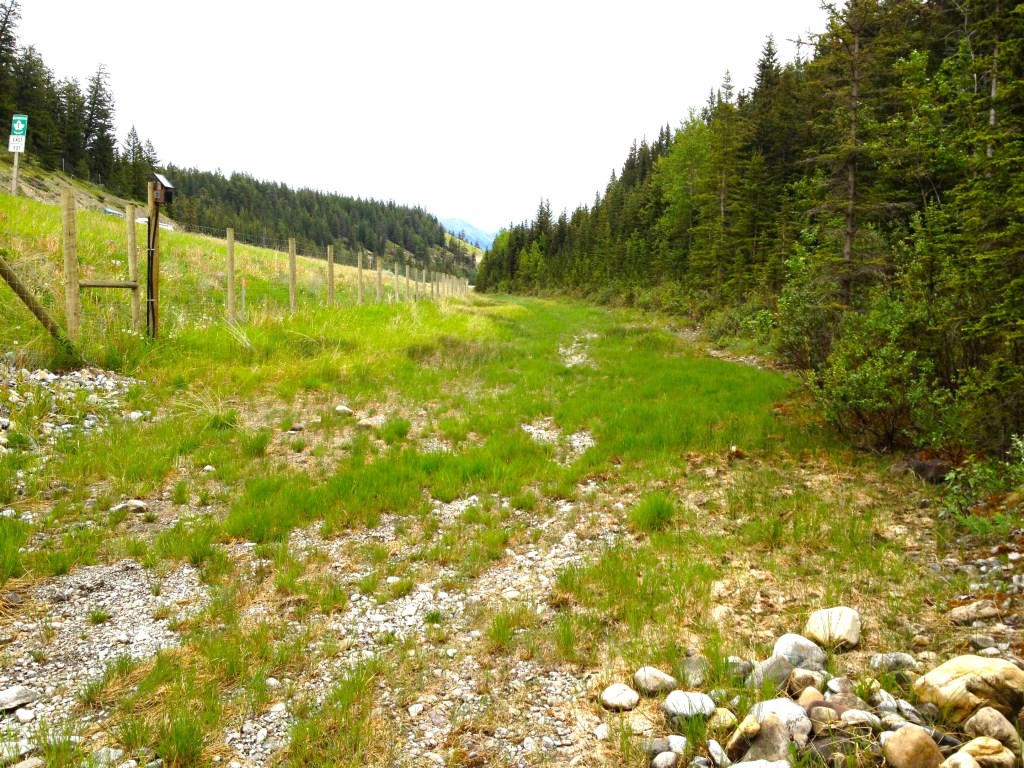
As part of a commitment to recovery of fish species at risk, Parks Canada put a priority on restoration of the nine kilometre section of the Cascade River from Minnewanka Reservoir to the Bow River in their 2010 Banff Park Management Plan. Only now it is Cascade Creek in deference to the reduced flow.
One has to stand in awe of those who proposed rehabilitating a mostly dry channel, some of it clogged with sediment from the occasional trickle, with essentially all the flow diverted. This was the brainchild of the late Charlie Pacas, a Parks Canada fisheries biologist, who did not have a faint heart when it came to righting a historic wrong. Bill Hunt, as the Head of Resource Conservation (now retired), took up the torch after Charlie’s death.
Sometimes in project implementation nothing succeeds as well as pure, blind luck. In June of 2013, before much work was started an upslope condition resulted in extremely heavy rainfall over a sustained period. Snowmelt was late and the ground was already saturated from several previous days of light rain. Water levels rose rapidly in Minnewanka Reservoir, to the point the dam structure was at serious risk of being overwhelmed. TransAlta opened up the emergency floodgates, the first time they had been used, creating a flood that raced down the old channel of the Cascade River.
Flood waters blew through several crossings, washing them out and carving a new, wide channel. All the accumulated sediment of over seventy years, over a metre deep, was washed downstream. Yes, infrastructure took a beating, but the flood was also an unintended habitat improvement event, especially for Cascade Creek.
One of the better decisions for project planning and implementation was to retain Dr. Robert Newbury, a “semi-retired” river hydraulics engineer, according to one Parks Canada person. Bob is the Canadian guru for understanding how streams function and what it takes to repair them. He was given a free hand to design and restore the stream—Charlie’s dream.
What Bob was confronted with was a wide ditch in many sections of the stream, with shallow, uniform flow, not good for trout. The task was to integrate natural, high quality habitats into built ones, add riffles, rapids and pools to increase hydraulic complexity, allow the stream to meander and create channel characteristics that suit aquatic insects and trout. Simple, right?
It started with an assessment of the characteristics of the existing channel using cross sectional profiles to assess widths, depths and water velocities at a range of flows. Then it was a question of how closely these characteristics matched the modelled results for the velocity and depth preferences of cutthroat trout and to identify what stream reaches needed a nudge. The geometry and complexity of pool, run and riffle sites (slope, rock sizes, spacing, pool depths, gravels, velocities and discharge) were measured and used to design the Cascade reaches.
Bob then walked each reach to determine where the existing good habitats were and to see how these could be integrated with built habitats. This is where he pointed out “It becomes a bit of an art, trying to copy a natural stream form in pools, riffles and meander bends.” As a template he had the natural design of a similar trout stream, in the Jumping Pound watershed, as a guide.
To achieve this for Cascade Creek took heavy metal, in the form of a tracked backhoe and a skilled operator, Larry Clark. Volumes of material had to be moved, placed and adjusted, often with the support of Parks maintenance staff. Sometimes it was the careful placement of boulders, just so, with the considerable finesse of a backhoe bucket. Every hundred metres the velocities and depths were plotted, compared with preferred cutthroat trout values and any segments that did not meet these criteria were altered with a combination of pools, riffles and meanders. The physical structure of the stream channel was completed in 2019.
Once the channel was reconfigured hundreds of hours of mostly volunteer time went into replanting the riparian zone with a variety of trees, shrubs, grasses and forbs. As Helen Irwin, who served as the Project Manager, related, “Imagine trying to dig a hole in large stream cobble to plant a willow and you have an impression of the labour involved.”
Riparian vegetation is the “green” rebar that glues stream banks together, resists erosion, provides a place for sediment to be deposited during high water and is a source of terrestrial insects for trout. The shading from trees and shrubs also helps maintain low water temperatures, essential for trout.
At the mouth of the stream, near the confluence with the Bow River, a fish barrier was built to keep non-native trout species out so they would not compete with native trout. A fundamentally important part of the project has been the willingness of TransAlta to restore and keep water flowing down the new channel.
Work done to rehabilitate the Cascade River and allow native trout to reoccupy the channel after nearly eighty years is a singularly tangible example of species recovery. Although it is still a work in progress the essential elements of a stream ecosystem have been reconstructed.
The reality is the work is by no means finished and, in such a dam regulated system, will required sustained attention and effort in perpetuity. This is the cost of working with severely modified riverine systems to achieve and maintain a self-sustaining native trout fishery. Monitoring by Mark Taylor, Aquatic Ecologist with Parks Canada, will determine if the trout give it a passing grade.
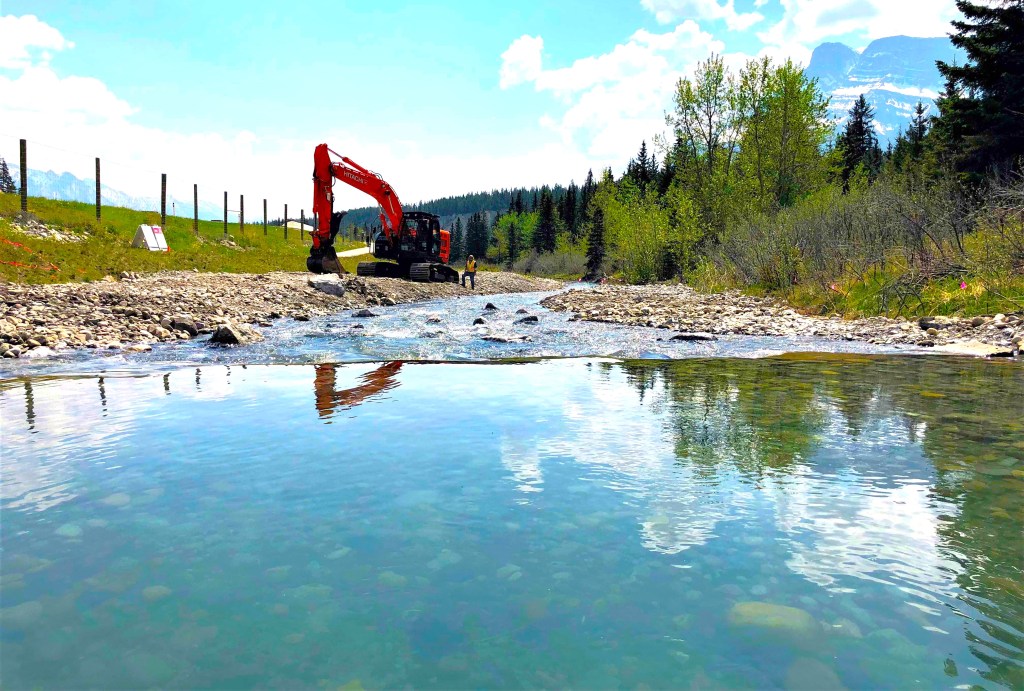
No one involved with the project would say it was easy (or will be), but the will and persistence displayed should motivate others to consider similar projects. Charlie Pacas’s “crazy” dream is a reality and others can be as well. This is what it takes to recover native trout populations at appropriate scales. It appeals to me because of the systems approach used by Bob, not a series of band aids.
Recovery efforts for native trout will only be effective if we can turn back the clock and restore the habitats historically occupied by them. Recreating a Cascade River does just that.
August 2023
Lorne Fitch is a Professional Biologist, a retired Fish and Wildlife Biologist and a former Adjunct Professor with the University of Calgary.


