[a bit of memoir from my time in Banff that will likely not make it into the final draft of my latest book project, but which seemed worth sharing]
A fundamental conflict built into Parks Canada’s organizational mandate is that it is responsible for both ecological integrity of living systems and cultural integrity of historic, mostly built, resources. But living systems are dynamic; there is no place in nature for stasis. Nothing is meant to persist forever; everything is meant to decompose. Life is not about objects that last; it is about processes of change and renewal.
The things that threaten our historic artifacts are actually the things of life: dry rot fungus, weather systems, leachate from bat droppings, carpenter ants, fire. Defending built heritage means waging constant war on… ecological integrity. So part of Parks Canada is devoted to promoting and protecting the forces of nature that destroy and renew and destroy again, while another part is devoted to fighting those same forces. Cognitive dissonance is hard-wired into the organization’s “heritage” mandate.
One rarely comes away from a conflict unscathed. That was certainly the case for me when I took on a challenge that my predecessors had — perhaps wisely — been kicking down the road for a couple of decades.
Arthur O. Wheeler was founder of the Alpine Club of Canada and a well-connected promoter of Canada’s mountain national parks. As such, he became a darling of the mountaineering movement and of the Dominion Parks Service that ran the young parks system. In a development-focused and pragmatic era, the national parks were on shaky footing because a lot of parliamentarians, reflecting the attitude of their electorates, saw them as frivolous and wasteful. They didn’t generate income, they left land idle and unused, and they cost the public treasury dollars that could be used productively elsewhere.
James Harkin, the political-savvy and idealistic bureaucrat in charge of Canada’s national parks, knew that aesthetic arguments and conservation rationales wouldn’t win over the cynics, so he worked hard to build a case for the national parks founded on their health benefits and their value in attracting tourists — and their dollars — to Canada. In that regard, allies like Wheeler were indispensable. It was normal in that era to reward friends with perks, and A.O. Wheeler did very well by Harkin. He was granted a large lease watered by hot springs at the base of Sulphur Mountain where he built a small resort cottage and surrounded it with gardens. It was a unique and beautiful property.
But time and the forces of nature have never been particularly kind to the works of man. Wheeler died in 1945 and his summer home fell into disuse. For all its attractiveness, it was an isolated spot, accessed by a short road off a blind corner on the road that connects the town of Banff with the base parking for a popular gondola to the mountain ridge above. It didn’t get a lot of sun, especially in winter, tucked as it was against the looming shadow of Sulphur Mountain. As tourism developments incrementally filled the adjacent valley floor, the springs and forests around the lonely cottage became increasingly important for wary animals like wolves, cougars and grizzlies trying to make a living in a busy landscape. The house was abandoned and fell into disrepair. The original lease lapsed and the property became an unencumbered part of the national park again.
That was the situation when, during the 1980s, Parks Canada and the town of Banff were faced with the dilemma of how to accommodate the park’s growing population. A building boom, fuelled in no small degree by generous capital grants and loans made possible by Alberta’s booming oil economy, created a need for staff accommodation. There wasn’t much room left in the town boundaries for new housing. Town planners and developers soon became focused on the Middle Springs area, on the western edge of the town, downslope from Wheeler’s abandoned estate.
Finding a good place for new housing development had been a challenge; getting approval to actually develop it was another. Parks Canada was already under attack from environmental groups for its failure to keep a lid on commercial growth. Wendy Francis and Harvey Locke, two talented environmental lawyers, were leading the charge on behalf of the Canadian Parks and Wilderness Society. At the local level, the Bow Valley Naturalists led by the deeply idealistic and brilliant Mike and Dianne McIvor were holding official toes to the fire. The media were being fed a constant stream of images and rhetoric showing how Parks Canada was failing in its duty to keep Canada’s oldest national park unimpaired for future generations by allowing developers and their local politician friends to urbanize the place.
Middle Springs faced an uphill battle for approval —as well it should have. Commercial development in Banff was almost totally out of control.
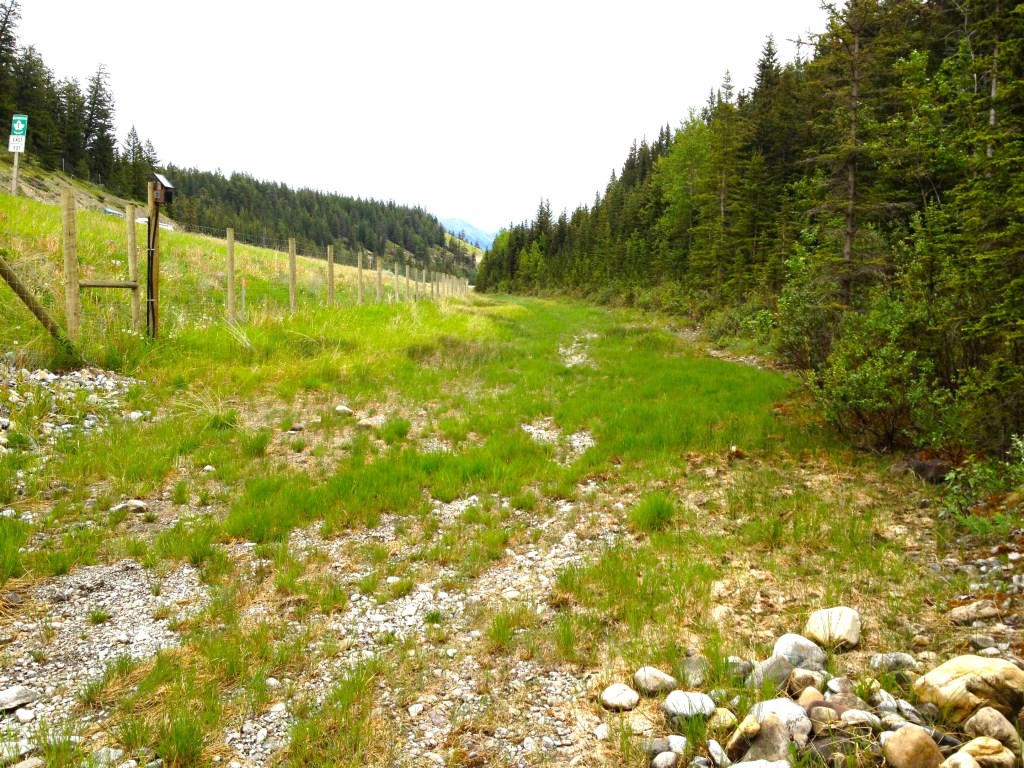
But the need was real, too. The upshot was that the housing development got approved, but only after a comprehensive and challenging environmental assessment that set a number of conditions to try and mitigate the impact of filling some of the best remaining habitat in the montane heart of the Bow River valley with yet more asphalt and buildings. One of those conditions was that the new development would be fenced in and the adjoining narrow corridor of forest on the uphill side would be permanently out of bounds to recreational use, leaving it for the exclusive use of the wildlife whose habitat would be lost to development. That corridor included the Wheeler property, and the environmental assessment prescribed that the old house be removed and the site reclaimed.
A.O. Wheeler was a historic figure of national prominence. He had not just promoted alpinism in the mountain national parks but had also done pioneering survey work along the Continental Divide, founded national organizations that were prominent in promoting national park ideals and tourism, and left his name all over the history books. Tearing down his house risked being seen as tearing down his legacy. It wasn’t the kind of thing for which park superintendents like to be blamed.
When I arrived in Banff two decades later, the house was still standing. Mostly. The roof had partly caved in and the gaping hole partly covered with plastic tarps. Bats had occupied the attic and bushy-tailed wood rats lived in the walls and under the caved-in floor. The place reeked of guano and was stained with fungus. Bureaucrats might have been reluctant to get the job done, but Nature was deconstructing the place in its own slow, inexorable way. The site had few visitors — it was now part of a closed area after all — but hosted occasional illegal bush parties and trysts. That created a liability risk, because the building’s increasing instability meant it might easily collapse on someone.
My naive view was that a deal is a deal, and that it was time to stop the dithering. Most of my management team agreed that it was past time to get the job done, before somebody got hurt in there. It would also remove a temptation that kept drawing people into an area we had reserved for wildlife. Closing the area was an inadequate effort to mitigate the impacts of a large housing development in one of the most ecologically-significant parts of a national park, but turning a blind eye to trespass made that effort even more inadequate.
When we announced that this can would no longer be kicked down the road, the reaction was fast and furious. Local artists and cultural heritage champions banded together to fight the demolition. Instead, they wanted the cottage restored to its original condition and the site opened to public use, as a sort of shrine to Wheeler’s legacy. Canmore-based novelist Katherine Govier joined with Wheeler’s great-granddaughter Jenny Crompton and other heritage advocates to lobby me directly and through the media. They were relentless, determined and — to a degree – right. The house and grounds had great historic value. That, however, should have been recognized two decades earlier before a legally (and morally) binding decision was made to sacrifice them for a housing development. In fact, the problem went back even farther, to when Wheeler’s descendants and champions, and Parks Canada, allowed the house to fall into disrepair in the first place.
Arguably, the real origin of the problem was the original decision to give Wheeler such a patronage award in the first place — at the expense of the public interest and the unique ecological values of the property.
Recognizing the validity of the heritage advocates’ concern, however, we looked for another solution. One option would be to remove the building to another site in town and restore it there, so that it could continue to serve as a place for visitors to learn about and celebrate Wheeler’s role in mountain history. But that idea proved unviable as the house was too far gone. The only person who stepped up with an offer was an opportunistic developer who said he would do it if we gave him a million-dollar lot — for free. It was pretty clear what his game was.
In any case, even if it had been possible to relocate and salvage the collapsing house, it would have lost a great deal of its historic value by being separated from the grounds on which it stood. I issued an access permit to a group of artists led by Jenny Crompton to enable them to spend a day on site documenting the house and its setting in ink, oils and watercolour, but that didn’t earn any goodwill; it simply strengthened their resolve to save the place from heartless bureaucrats.
When I finally set a firm date for removal of the house, the defenders went over my head to the Minister of Environment, the late Jim Prentice. That sort of thing happens a lot in Banff, but usually the Minister’s office wisely stays out of the crossfire and simply sends the lobbyists back to the park superintendent. In this case, however, Prentice’s staff felt it warranted his attention.
It was 2010 and the eyes of Parks Canada’s senior executive cadre were fixed even more intently on Banff than they usually are, because this was the 125th anniversary of Banff National Park and, consequently, of Canada’s system of national parks. Just as in Harkin’s era, Parks Canada’s senior administrators faced the ongoing challenge of persuading skeptical politicians of the importance of spending public money on places that couldn’t be logged, mined or otherwise exploited for profit. And just as in those earlier times, tourism and recreation were the selling point. So the anniversary was seen as an opportunity to build more buzz that would attract more visitors to an already desperately-overcrowded national park. The powers that be informed me and my colleague Pam Veinotte, who was superintendent of a field unit that included Kootenay, Yoho and the western part of Banff National Park, that we would be hosting a big celebration.
Then-Environment Minister Jim Prentice would be there. I got a message from the office of Parks Canada’s Chief Executive Officer that Prentice wanted me to meet with him about the Wheeler house. The stakes suddenly felt a lot higher; I finally understood why previous superintendents had chosen to leave that matter undealt-with.
The Minister met me at the Banff Springs Hotel. He had half an hour, and he wanted to see the house. Prentice, an intelligent and results-oriented guy, was all business. We got in a car and headed down the hill to the junction with the Sulphur Mountain drive. I had a binder of photographs, interior and exterior, of the house that Steve Malins, Banff’s cultural heritage specialist, had handed me the day before. I hadn’t asked him to prepare it, so I was both impressed by and grateful for his initiative in doing so. I handed it to Prentice and he leafed through it as I drove.
As we drew near, I directed the Minister’s attention through the trees to the brief glimpses of the house visible there and explained that I was a bit reluctant to turn into the grassed-over and gated access road given the traffic hazard at that corner. Prentice looked up from the binder, then nodded and said, “That’s okay. I think I’ve seen what I need.”
We turned around at the Upper Hot Springs parking lot and I delivered him back to the hotel. We shook hands and he told me his office would get back to me the following week. As he walked away I felt a bit bewildered; I wasn’t really sure whether things had gone well or poorly.
On the assumption that Steve’s binder, with its images of rotting walls, fallen-in roofs and guano had done the job, however, I called John Rose, the park’s Asset Manager, and told him he should have the demolition contractor on site and ready to go the following Wednesday morning. At nine in the morning I got a call from Ottawa; we should proceed with whatever we had decided to do. I hung up and called John Rose. Fifteen minutes later he called me back to let me know that the house was now a pile of partly-rotted wood and the crew was starting work on cleaning up the site.
I was now confirmed as the devil incarnate in the eyes of some good people who were completely correct on the historical value of what was now gone forever. The conflict between protecting nature from development, on the one hand, and protecting built history from nature on the other, had been resolved in favour of nature. Crompton, Govier and their contingent saw my decision finally to get that job done as proof that Parks Canada simply didn’t value history. It didn’t, of course, prove that at all; if anything, it showed that development pressures had once again won at the expense of the national park’s heritage values – both cultural and ecological.
But perhaps not quite. That very same week Skoki, a young wolf from the Bow Valley pack wearing a radio-collar that enabled park biologists to monitor its travels, used the Wheeler estate and the wildlife corridor of which it was a part to squeeze past the teeming town of Banff and escape into the peace of the Spray River valley, en route to the Kananaskis valley. There Skoki became the founding father of a new wolf pack. His sensitive nose was doubtless assailed by the alien odours of domestic dogs, people, lawn fertilizers and engine exhaust as he wended his watchful way past the Middle Springs housing development and through the mildew-scented opening where the old house had stood. But he made it, because he could.
 Kevin Van Tighem