Iiníí

Early in November, 1887, John Nolan and other half breeds were near the forks of the Red Deer and South Saskatchewan when they came across a bunch of eleven buffalo, one of the bunch being a very large bull. They killed the big bull, two cows and a calf and brought them into Swift Current.  J. Grant got the head of the bull and Curry Bros.,  got the two cows heads and hide of the calf. No doubt afterword the half breeds cleaned out the rest of the bunch for they were never heard of again.

Hine of Winnipeg mounted the bull’s head and in 1893 it was loaned to the government and was sent to the World Fair at Chicago, where it was much admired…

The country lying between the South Saskatchewan and the Cypress Hills and Old Wives Creek and the lakes and the Vermillion Hills was famous for Buffalo and even now the old Buffalo trails and wallows are to be seen from Moose Jaw to Medicine Hat.

from a letter by “Wyoming Bill” to the Fort Macleod Gazette, 1902
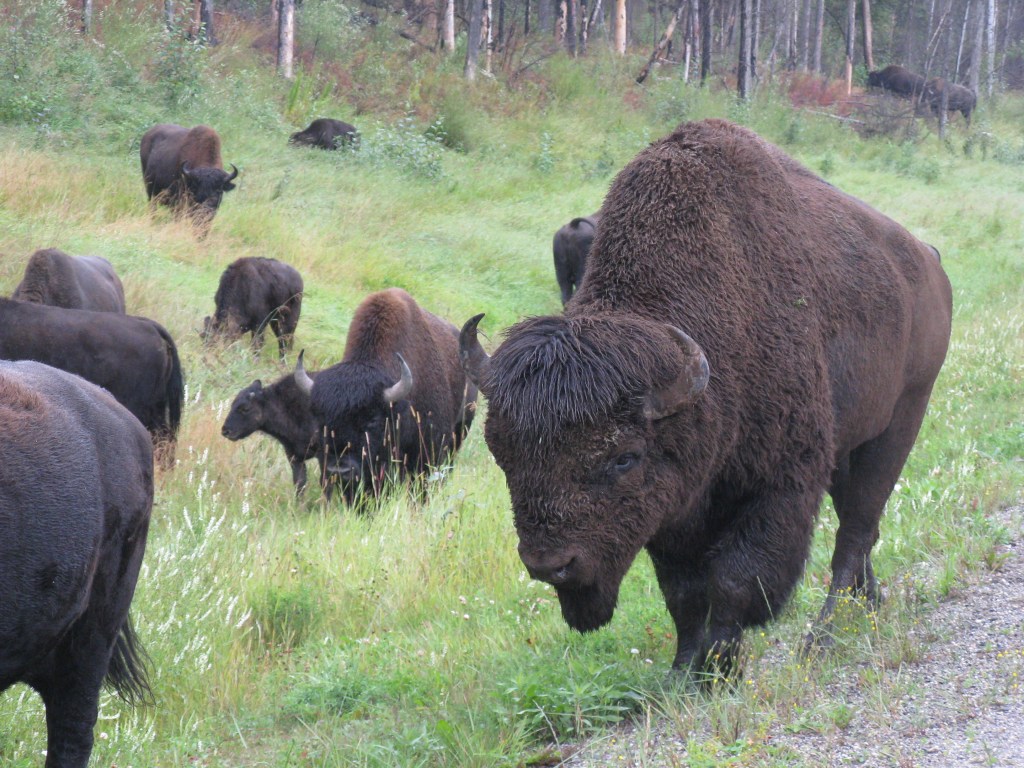
Treaty Seven was signed in 1877. Barely ten years later, Canada’s last wild plains bison expired its last breath into the prairie sky. 

Canada’s first prime minister, John A. Macdonald, thought the eradication of North America’s largest land mammal was a very good thing.  “I am not at all sorry,” he said to Canada’s House of Commons in faraway Ottawa. “So long as there was a hope that bison would come into the country, there was no means of inducing the Indians to settle down on their reserves.”

The treaties at least assured the Indigenous tribes of the western plains that they would not starve. In exchange for that and other assurances, they settled on the reserves they had chosen and tried to come to terms with a world turned upside down. How could there be no buffalo? 

The Ghost Dance movement that originated with tribes who lived in the Great Basin region of the US spread through many of the plains nations. It was a spiritual practice whose adherents hoped would bring back the world they had always known, including the vanished bison. They were desperate in their loss; a world they had never imagined could end, had.

But the bison were gone for good. Settlers were coming to populate the empty plains. The newcomer people replaced the native bison with a newcomer animal: the domestic cow.

MacDonald’s government wanted to build a new nation from the Atlantic to the Pacific Ocean, and to secure its control over that nation before the Americans, who had a head start on settling the west, could appropriate the place for themselves. That was the basis of MacDonald’s National Policy.  His government’s problem, however, was that the land was vast and there were people living there already. The decision to negotiate treaties with those native peoples was, from the Dominion of Canada’s point of view, more a pragmatic than a principled one. They needed peace and order, so they had to negotiate.

As soon as the treaties were in place, the Canadian government started cutting other deals to secure its control over the land. First they arranged to build a railroad across the southern edge of the country. Until that was done there was no practical way to fill the place with farmers. So, as an interim measure, the government issued grazing leases of up to 100,000  acres to well-financed eastern Canadian and British investors.

That was another pragmatic decision. For one thing, it pre-empted any move by Americans to settle the lease lands. The new railway could ship beef as a source of revenue to start paying down its debt. And, perhaps most importantly: the government had promises to keep. It needed a supply of meat for thousands of Indigenous people now faced with the prospect of starvation.

The first huge grazing lease went to a well-connected Ontario conservative, Matthew Cochrane. He sold shares in his Cochrane Cattle Company to a few wealthy friends from Montreal and the Eastern Townships, imported some breeding stock from Europe, and arranged for two big shipments of mixed-breed cattle to be trailed north from Montana.  The new lease was centred on what is now the town of Cochrane; the home ranch was at the mouth of Bighill Creek.

Cochrane and his investor friends hired a well-respected mountie, James Walker, to run the ranch. Walker was a rigid, letter-of-the-law kind of guy, which had served him well as a policeman. When his bosses told him to do something, he did it. Unfortunately, that obsequiousness didn’t serve him well in his new job.

The investors had put a lot of their money into this new ranching enterprise, and they wanted to see profit sooner rather than later. They told Walker to get those American cattle onto that Canadian grass as quickly as possible. He followed their orders diligently, pushing a herd of 6800 tired cattle hard in order to get them to the Bow River grasslands before winter.  They arrived in bad shape just in time for one of the hardest winters on record.

Cattle aren’t bison.  When the north wind blows, bison turn their big, hairy heads into the wind and paw away the snow, grazing their way into the storm.  Cattle turn their backs to the wind and drift ahead of it. When snow covers the grass, from a domestic cow’s point of view the grass has gone. They don’t crater down to it like bison, elk or horses do.

Bison would have weathered the hard winter of 1881-1882 easily, but they were gone. The newly-imported cattle piled up against fences or in the deep drifted snow of coulees and river breaks. Most died.

The following year, again following orders from eastern bosses who had no idea of the West’s environmental realities, Walker drove another 4300 head of cows north from Montana during a dry, thirsty summer. The same disaster happened all over again that winter. 

Of the more than 11,000 domestic cows Walker brought north, by the spring of 1883 only 4,000 survived. Coyotes and eagles had a great spring; there was food galore. It was not a great spring for wealthy white men with high hopes for extracting big profits from the far frontier. They blamed Walker, even though he had simply followed their orders.

Only two decades earlier, there had been hundreds of thousands of bison here. They knew how to live there. So did the people who lived among them. But the future had arrived. Nothing about it was going to be easy, now that the place was full of strangers.

A century and a half later, the human population of Alberta has increased from less than 50,000 at the time of Treaty Seven to almost 5 million today. A gridwork of roads crisscrosses the plains and continues to metastasize into the boreal north. Towns have grown into cities and cities have grown into metropolises. It might seem like the buffalo days have been left forever in the past.

That would be a misconception. The buffalo have returned. Their reappearance in a land that had almost forgotten them might seem as impossible as their original disappearance was to the Niitsitapi who had lived with them so long. Even so, it is well underway.  Who knows what might happen next?
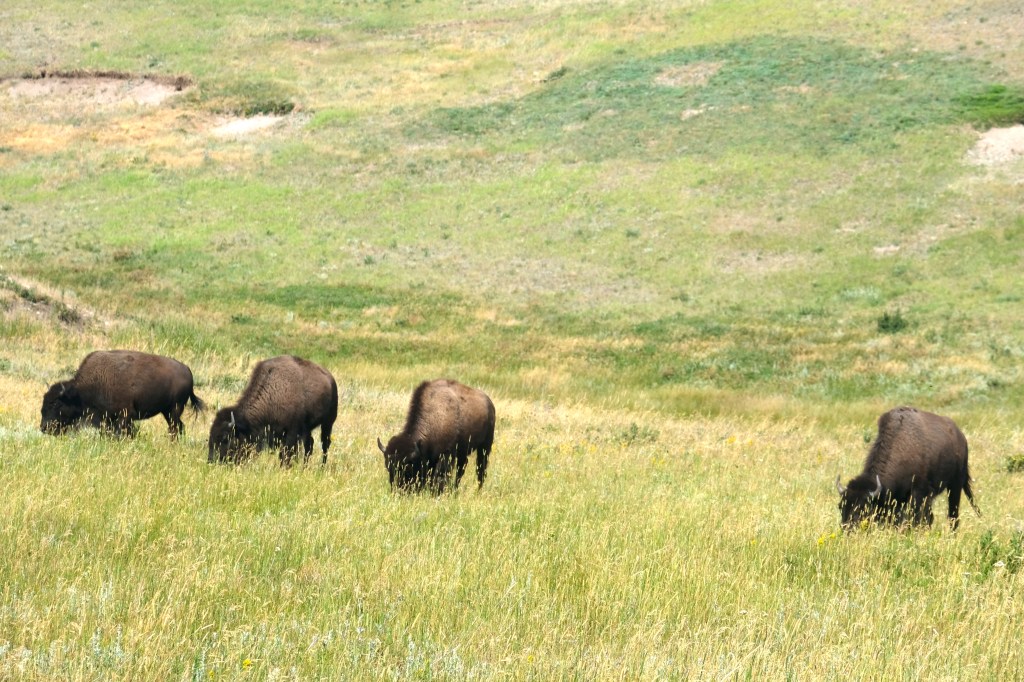
I met Wes Olsen in the early 1980s when I was assigned to a bird inventory project at Elk Island National Park, east of Edmonton.  I was still with the Canadian Wildlife Service, and Wes was a park warden responsible for the care of the park’s herds of pure-strain wood and plains bison. Tall, moustached and soft-spoken, Wes comes across more like a cowboy than an ecologist, but appearances can be deceiving: he is North America’s leading authority on the ecology and reintroduction of bison.

Wes was responsible for keeping Elk Island’s herds free of disease and for helping keep the population in balance with the available supply of forage. That meant that the herds had to be culled periodically. Rather than kill the surplus animals, though, Wes and his colleagues arranged for them to be transferred to new homes: bison ranches, small display herds in other prairie parks, First Nations reserves and even an ambitious project to restore some of the original Pleistocene megafauna to northern Russia. The Elk Island animals are considered the gold standard for bison recovery because they contain no domestic cattle genes and are kept free of the diseases that domestic cattle brought to North America.  Anthrax, brucellosis and tuberculosis have infected other conservation herds, including those in Wood Buffalo and Yellowstone National Park.

When Pierre Trudeau’s federal government established Grasslands National Park in the Frenchman’s River area of southern Saskatchewan in 1981, the park had no bison. Parks Canada imported plains bison from Elk Island in 2005 and, soon after, imported Wes Olsen too.  As the herd grew, Wes and his wife Johane Janelle studied the ways in which the big animals changed the prairie and its wildlife fauna. They soon realized that, just as the absence of bison had changed everything, their return also changed everything — for the better.

Bison wallows create small hollows that fill with meltwater each spring and create breeding habitat for frogs and insects. Bison shed their wooly underfur each spring; songbirds use the wool to line their nests. Bison wool not only provides superior insulation for eggs, it also disguises the odour of the nestlings, increasing both hatching rates and nestling survival. Literally hundreds of species of insect and other arthropods are attracted to bison droppings. Some of those insects burrow into the ground, increasing the soil’s porosity and enabling rain to soak in more thoroughly. Others are vital food sources for horned lizards, loggerhead shrikes, sage grouse and other species that were once abundant but are now endangered. In winter, pronghorns, deer and grouse feed in the snow craters that grazing bison carve out of the snowpack.

Wes describes the plains bison as a keystone species — a species whose presence or absence has much more far-reaching effects on their ecosystem than other animals. Beavers are another keystone species. So are we.

In 2022 Wes and Johane released The Ecological Buffalo, unquestionably one of the best books of applied ecology ever published in Canada.  It details the many threads of connection linking plains bison and the rest of the prairie ecosystem. The sheer complexity of the relationships Wes and Johane describe is a sobering revelation of what was lost when that last prairie bison fell to a hunter’s bullet a century and a half earlier. But it is also an awe-inspiring revelation of what prairie Canada might again be, if the bison were to return.

And it’s not a question of if, any more. It’s happening. 

In 2005, bison returned to Grasslands National Park. From an initial release of 71 young animals from Elk Island, the herd has grown to more than 500. Their trails, wallows, dung and grazing patches again shape that relict prairie ecosystem. They graze among prairie dogs and long-billed curlews. Their odour mingles with that of sage and wild rose. The place is real again.

Thirteen years later, another 16 plains bison went from Elk Island to a new home in the wilderness of northern Banff National Park. That herd, which regularly encounters grizzly bears and wolves, has since grown to more than 100. They range widely from alpine meadows through burned-off mountain slopes to the fen meadows along the headwaters of the Panther, Dormer and Red Deer Rivers. The herd may soon outgrow the available range. The need to trim the herd has led to another restoration — that of the age-old hunting traditions of the Iyarhe Nakoda and Siksikaitsitapi.  The return of bison to Canada’s first national park — a park whose origin story includes the ejection of those Indigenous people whose homeland it had always been — may help heal more than just the land.

“What would happen if you took the cross away from Christianity?” Kainai elder and teacher Dr. Leroy Little Bear said when I interviewed him in 2017. “The buffalo was one of those things.  The belief system, the songs, the stories, the ceremonies are still there, but that buffalo is not seen on a daily basis…The younger generation do not see that buffalo out there, so it’s out of sight, out of mind.”

Little Bear played a pivotal role in drafting the Northern Plains Buffalo Treaty, the first Treaty among Indigenous nations in over 150 years. Initial signatories in the fall of 2014 included the Siksika, Piikanii, Kainai and Tsuu T’ina First Nations as well as Assiniboine, Gros Ventre, Sioux, Salish and Kootenai tribes from south of the 49th parallel.  The Stoney Nakoda First Nations signed on a few months later. Other First Nation groups continue to join the treaty each year.

“The Buffalo Treaty is very historic,” says Little Bear. “A treaty among just Indigenous cultures to work together on common issues: conservation, culture, education, environment issues, economics and health research. In the centre of that is the buffalo.”

“Our elders said, we want to restore the buffalo. But it’s a big job. We can’t do it on our own. We need partners.”

Marie-Eve Marchand, a passionate conservationist of Quebec settler stock, is one of those partners.  She was a founding member of Bison Belong, an advocacy network formed in 2008 to pressure Parks Canada to follow through on its commitment to bring bison back to Banff National Park and to build social license for the initiative.  That work successfully completed, Marchand moved on to provide administrative support and media coordination for the Buffalo Treaty. She worked with both Niitsitapi and their allies from among the newcomer peoples on the Iiníí Initiative, which was meant to rematriate bison in Niitsítpiis-stahkoii — Blackfoot territory. 

“We eliminated the beaver and the bison, both keystone species,” she says. “Now we are turning that around.”

“With the return of the buffalo,” Dr. Little Bear adds, “those things that were part of those regularly occurring patterns in nature, the buffalo was part of it. So we’re bringing back those regularities and those regularities are part of what anchor our societies.”

“But there’s a whole lot more. There’s also their larger role in the ecosystem.  As a human species, we play a very small role in that ecosystem. And it’s a big job to bring about an eco-balance. So we need help and the buffalo will do that.”

Two years after the initial signing of the Buffalo Treaty, the homecoming of Iiníí became more tangible, with the arrival of 88 plains bison in northern Montana from Elk Island National Park. Their new home was a tribal ranch on the Blackfeet Reservation. They were home, but still behind fences. Then, in 2023, the Blackfeet released 25 bison into their ancestral range on the foothills slopes below Ninaistako. Wild bison were back in the Crown of the Continent.

Tristan Scott of the Flathead Beacon was present to report on the homecoming. Tribal elder Ervin Carlson told him, “To see them out here, it just choked me up. It’s a real good feeling. It finally feels right, after feeling wrong for a long time.”

It finally felt right. But for most of the twentieth century, it was unimaginable. Our only bison story was one of loss. What else might we imagine? We live in a landscape our choices shape, and in a landscape of possibilities our stories create. We have a new story now, a better one. Those landscapes are changing for the better.

If the bison can come home, perhaps we can too. All of us, together, as the Treaty People we are meant to be.
Good Relations

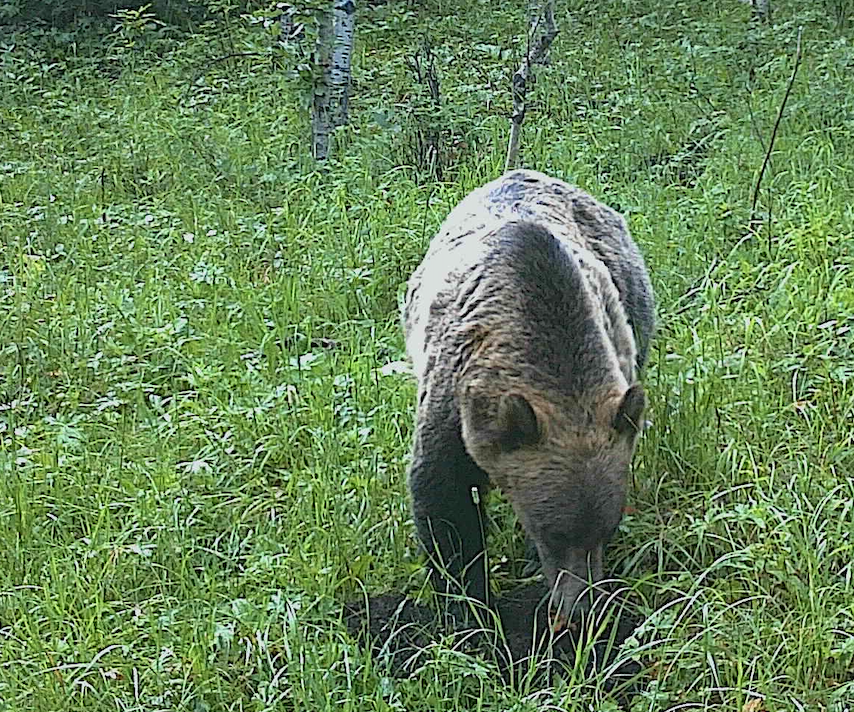
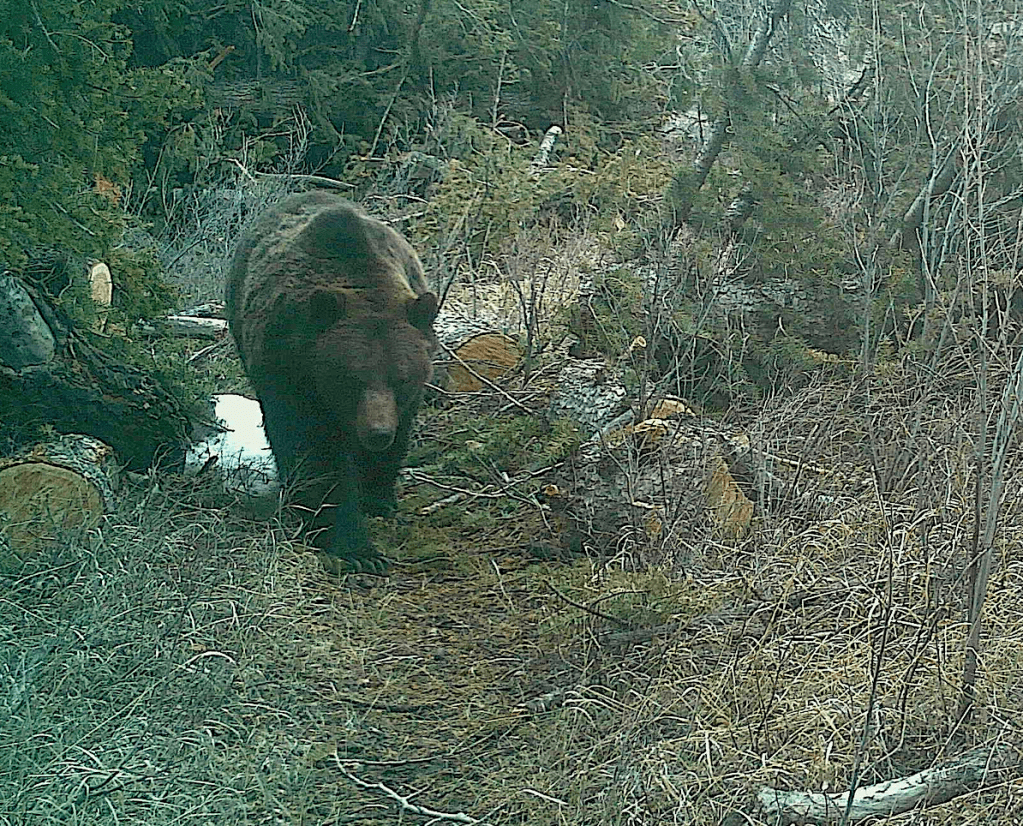
One rainy morning in the Front Ranges of Banff National Park, having just waded the icy-cold Panther River, I rounded a bend in the trail, and there was a grizzly bear.  The slope had been burned a few years previously, and the bear was rooting in the lush greenery among the black snags.

I had no intention of turning back, but neither did I feel it would be respectful or wise to try to pass so close to the oblivious bear. After a bit of thought, I pulled out the black plastic garbage bag that was protecting the top of my backpack and tied it to the end of one of my hiking poles.  Then I waited until the grizzly finally turned in my direction and spotted me. I waved the garbage bag over my head; the bear flipped ends and took off at a trot up the trail.

Fifty metres on, it half-turned and raised up on its hind legs, then leaned forward in a rabbit-like pose, and projectile-pooped a gusher of green into the woods. Having jettisoned its ballast, the bear dropped to all fours and bolted away up the mountainside.  I didn’t bother examining the deposit as I walked past, but the odour was a fecund mix of decomposed greenery and grizzly bear digestive system.

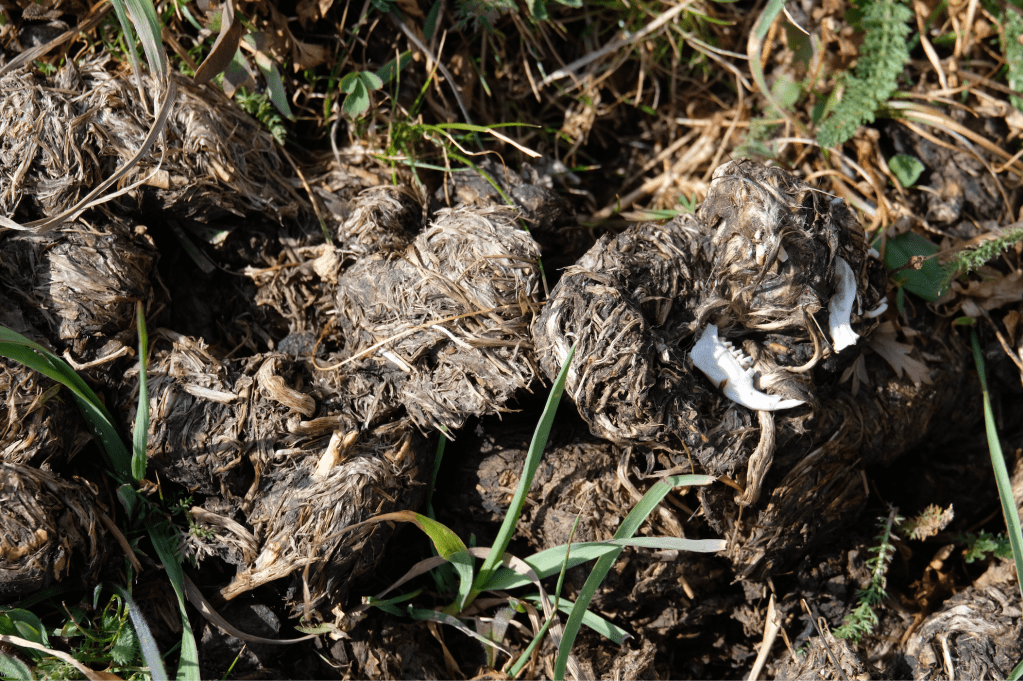
A normal odour for that country.  Bears eat a lot of vegetation — young grass and horsetail shoots, dandelion flowers, sweet vetch roots, glacier lily and spring beauty bulbs, and the berries of saskatoon, huckleberry and strawberries.  Their digestive systems aren’t suited for breaking down cellulose and other stringy bits, so a lot of what goes down the hatch comes out the other end relatively unchanged.  The good bits — sugars, proteins, easily-digested chemicals — remain behind. One reason bears are so food-obsessed is because they eat a lot to get relatively little.  Deer, elk, bighorn sheep and bison digest a lot more of what they eat because of their ruminant stomachs — fermentation vats where bacteria and other simple organisms help to turn the unpalatable bits into digestible material.

In order to let their rumen stomachs get that job done, ungulates have to spend a lot of time just lying around, chewing their cuds.  Bears, on the other hand, need to keep travelling around to get the nutrition they need.  They eat, they excrete, they eat some more.

Hiking the Wishbone Trail in Waterton Lakes National Park one day, Gail pointed out a tiny forest in the middle of trail.  The blob of newly-sprouted seedlings, like a flattened chia-pet, was bear poop.  The autumn previously, having filled itself up with chokecherry and saskatoon fruit, a bear had paused in the middle of the trail to deposit the remains and make room for more. The resulting pile, after spending the winter under the snowpack, had sprouted dozens of baby shrubs from seeds the bear had failed to digest.

A BC researcher, Aza Fynley Kuijt, tracked 74 grizzly bears and conducted germination experiments on wild huckleberries.1 She found that berries need bears as much as bears need berries.  “Bears don’t just eat huckleberries—they help them grow in new places,” she said. “Our findings show that this mutual relationship is crucial for both species, especially as climate change shifts suitable habitats for huckleberries.”

Left to themselves, huckleberries usually fail to reproduce. Less than 1 in every 500 seeds in a huckleberry fruit can actually sprout without help, because the seed coats have chemicals that inhibit growth. In the gut of a grizzly, however, digestive juices remove those chemicals. Kuijt’s research team found that at least a third of the huckleberry seeds excreted by bears subsequently sprout.  And since bears travel a lot, those berries often sprout in new places — half the seeds excreted by bears were more than a kilometre from the bushes that produced them, and some got deposited as much as 7 km away. 

Bears and berries live in dynamic landscapes. Trees invade meadows and gradually shade out berry patches, enabling other more shade-tolerant plant species to take over. On the other hand, fires and avalanches sometimes kill forest stands, creating new openings of the sort in which berry bushes thrive.  Bears, in exploring their home ranges, help bushes like huckleberry, saskatoon and chokecherry find and colonize those places.  In turn, the vigorous new berry stands help bears build up their fat reserves each summer and fall, helping them survive through the winter hibernation period. Berries and bears would both be less abundant if they didn’t have one another.

As a student of ecology in the late 1970s, I was taught about symbiosis, a process by which two species come to rely on one another. Symbiosis was considered a bit of an anomaly in a world of inter-species competition. The belief that nature is usually red in tooth and claw — with relationships among plants and animals defined by competition, not cooperation — flowed naturally from the dominant paradigm of the culture in which I was raised, one based on competitive capitalism and a cutthroat market economy that yields winners and losers. 

Cooperation between species was so….socialist. And surely that couldn’t be natural.

A half century later, the competitive paradigm has been turned on its head.  Symbiosis is no longer seen as an unusual phenomenon — it is the very nature of life and place. Nothing exists in isolation. We are all in this together.  Competition among organisms may help drive change and evolution, but the mutually-sustaining relationships among organisms are what keeps everything working.  Things don’t exist in opposition to one another; they exist in communion with one another.

The relationship between grizzly bears and berry bushes wasn’t considered to be an example of symbiosis back in my student days, because it was assumed that the benefits only flowed one way: from berry to bear.  In reality, as Fynley Kuijt wrote, “Considering the ecosystem services bears provide to the germination and dispersal of shrubs such as huckleberry, the mutualistic relationship between bears and huckleberry should be recognized as an important ecosystem function.”

It should be considered more than that. It should be considered a defining element of what it means to be a real bear, and of what it means to be a real huckleberry.  An individual does not exist in isolation from its relationships; it exists as a consequence of them. Without the huckleberry, grizzly bears would still be bears, but they would be less complete ones.  Without bears, huckleberries would still be bushes, but incomplete.  And neither would live where they do today, and in the ways they do today. They help make each other who they are.

One summer Gail and I took our children on a road trip down the Rocky Mountain chain to the southern edge of Colorado, a journey that took us through the San Juan Mountains. This was where Colorado’s last known grizzly bear died in 1979. The old female bear attacked a hunting guide in self-defence after having been surprised at close range. Against all odds, he managed to kill her by pushing a hunting arrow into her throat as she mauled him.

That incident happened in the southern edge of the San Juans, but as we drove through those mountains it seemed to me it could have happened anywhere there. The San Juans are some of the finest-looking grizzly bear habitat I’ve ever seen: long, steep green avalanche meadows, rich riparian mosaics along tumbling trout streams, aspen forests and dark timber. Grizzly bears simply belong there. But for almost half a century, they have been gone. There are still plenty of black bears to gorge on saskatoons, huckleberries and other wild fruit crops there, and to deposit the undigested seeds in new settings, but the once-abundant grizzly bears are gone. A relationship that once defined both the grizzly and the San Juans has been ended.

Those mountains had a forlorn beauty about them. Like faded paintings, they were less than they should have been. There was a smallness that hadn’t always been there; like an empty chair at the family table, when someone won’t be coming home again.

Grizzly bears have many relationships that make them who they are, and that help make other things who they are too.  A few months after that Colorado visit, I rode up Yarrow Creek with other park wardens, heading for a trail that follows the Waterton Lakes National Park boundary west from the head of the valley.  For well more than a kilometre, the floodplain meadows looked as if they had been rototilled by some wilderness gardener.

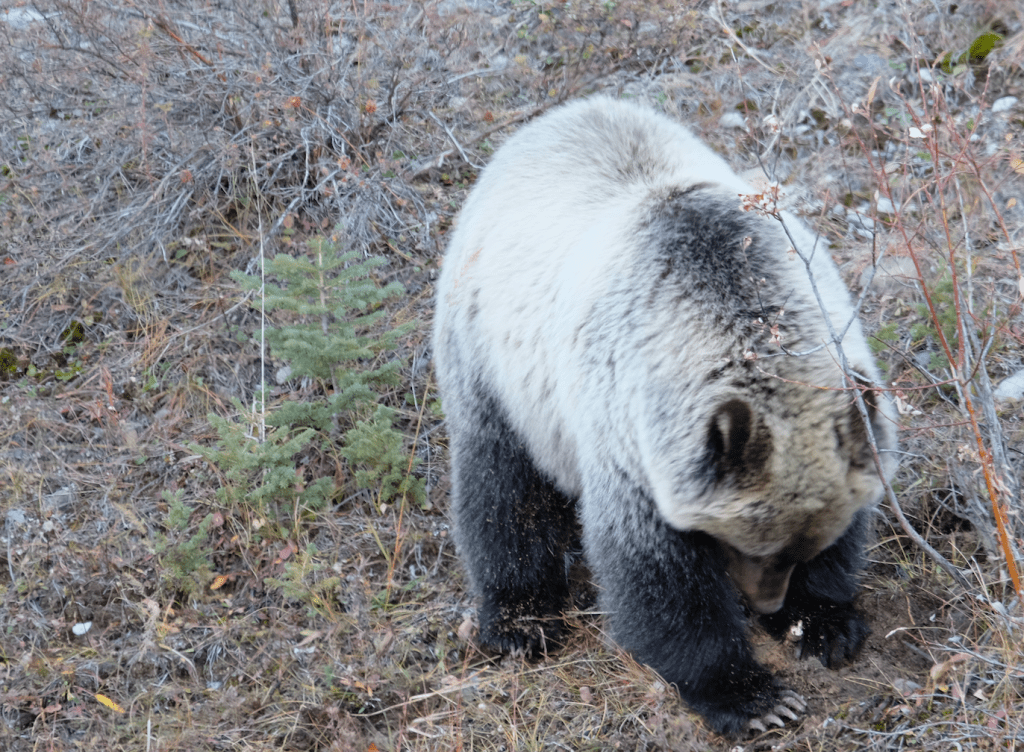
Indeed they had; the churned up meadows were the work of grizzly bears. Constantly rearranged by spring floods, mountain streams tend to meander along their valley bottoms, every so often changing course and leaving their former channels to fill gradually with vegetation.  Some of the colonizing plants are valuable bear foods.  Sweet vetch is a particular favourite in early spring and late fall, when the stringy roots are full of stored starches and proteins.  Glacier lilies and their bright little companions, spring beauty, similarly store nutrients in underground structures – bulbs and corms.  Grizzly bears follow their noses through the meadows and use their powerful forelegs and long claws to tear up sods and eat the hidden treasures.

But just as is the case with berry bushes, those bears are not exploiting that food source; they are sustaining a relationship.  Sweet vetch and other floodplain plants are pioneers.  They thrive best on recently disturbed ground where there is little competition from other plants.  As the meadows mature, those other plants take over and the pioneers gradually become scarce.  When a grizzly bear digs its way through a meadow, however, it sets the successional clock back by creating anew the raw, fresh soil in which those plants thrive.  At the same time, it leaves fragments of roots and bulb in the newly cultivated soil.  When human gardeners do that, it’s called dividing perennials. When bears do it, it’s the same thing. Bears are gardeners too.

Sweet vetch would still exist if there were no grizzly bears. It still grows in the San Juans, after all. But its distribution and abundance are different there than when its relationship with the grizzly bear was still intact.  Along Alberta’s Rocky Mountain front ranges, whole slopes of yellow and purple sweet vetch offer mute evidence that the great bear still lives here; they would be limited only to soils renewed by other kinds of disturbance if it didn’t.  Like in Colorado.

Popular hiking trails like Chester Lake, in Alberta’s Kananaskis Country, are closed annually to allow grizzlies to forage in peace in glacier lily meadows that would have become grass and willow long ago if it weren’t for the annual renewal of a relationship that benefits both the flowers and the bears — and hikers, who thrill to the sight of the bear diggings, watch the forest edges warily, and take pleasure in the delicate, golden beauty of the lilies.

Those relationships do more than benefit the plants, the bears and the hikers. They define them. Each is, in part, the other because each helps make the others whole.  Flowers, bears… hikers too.

Hikers in the San Juans don’t see roto-tilled meadows any more. They don’t worry about surprising a grizzly bear. “It must be poor life that achieves freedom from fear,” wrote legendary conservationist Aldo Leopold back in the 1940s. Grizzlies still occupied the San Juans then, but Colorado was well on the way to achieving the poor life of which Leopold warned. Colorado’s mountains today remain no less beautiful, but there is a hollowness there that makes them less than they were, and that makes those who sojourn there a little less whole too.

The bear makes the huckleberry more of what it was meant to be.  The huckleberry makes the bear more of what it was meant to be.  And both, I would argue, make us more of what we were meant to be.  Our relationships, after all, are who we are.

One August morning Gail and I hiked in to a sunny mountainside in southwestern Alberta to pick our winter supply of huckleberries.  It was a bumper year; the bushes were heavy with fruit. We were soon lost in the task, hunkered down a few metres apart, surrounded by the peace and beauty of the place. Birds rustled in the bushes around us, filling up with fruit that would help to power their fall migration flights. Huckleberries have many relations; some have feathers.

A particularly loud rustle made us look up. Maybe ten metres away, a grizzly bear had just stepped around a spruce tree and discovered that this berry patch was already taken. We were all taken aback, especially Gail who was closer to the bear than me and had also left her bear spray by her pack.  But the grizzly evidently had the same understanding of berry-picking etiquette as we did, and it turned and retreated into cover, leaving the patch to us.  Not entirely fair, as there is a good chance that one of its ancestors had relieved itself there and helped get those berries growing, but the whole mountainside was covered with fruit, so there was plenty to go around. The bear huffed its way past us a few minutes later and was soon comfortably ensconced in his own patch, farther up the slope.

The mountains paid no attention to the encounter. They have their own relationships with the world and they live in far deeper time than the rest of us. To the mountains, we were probably all one thing; part of its coat, as it were. The berries, the bear, the humans — I suspect those mountains saw us all as one.  In ways that matter to the workings of this world, we are.  And we’re all the better for it.

  1. Kuijt AF, Burton C, Lamb CT (2024).  Effects of bear endozoochory on germination and dispersal of huckleberry in the Canadian Rocky Mountains. PLoS ONE 19(11): e0311809. https://doi.org/10.1371/journal.pone.0311809 ↩︎

Disaster

[an invisible friend, one of many on Facebook, edits an online magazine called Hubris. An American, she sent out a plea for essays that might help her, and many others who think and feel in the same way, come to terms with the outcome of their recent election. So I tried (apologies for the Imperial measurements; I wrote it for an American publication):]

There is a pinch point in the Rocky Mountains chain that geologists call the Lewis Overthrust.  It extends across the US-Canada border and includes two of our oldest mountain national parks: Waterton Lakes, in Canada, and Glacier, in the USA. The subterranean paroxysms that gave rise to those western mountains were so powerful here that they pushed slabs of mountain rock over top of each other, like overlapping dominos, until that shifting rock had buried whole ranges of mountains and foothills.  Drive up to the Lewis Overthrust from the east and the effect can be startling: the prairie ends and the mountains are there.  No transition.

That orthographic pinch point lies east of a flattening in the landscape: the Columbia plateau. Those two geologies combine to create the perfect storms.  Storm after storm; westerly winds sweep inland from the Pacific Ocean and, finding little resistance through the Columbia plateau, pile up against that skinny bit of mountains before spilling over the top and sweeping down to the prairies.  It’s a continental-scale Bernoulli effects that yields relentless winds on the eastern side of the mountains, with gusts that regularly exceed 80 mph.  Anywhere else, that would be called hurricane-force.  In the lee of the Lewis Overthrust it’s called the chinook wind.  When we lived in Waterton, it sometimes blew our children down the street.  Fortunately, it blew them to school. Getting home could be a bit of a problem.  They wore ski goggles in winter, and sometimes crawled.

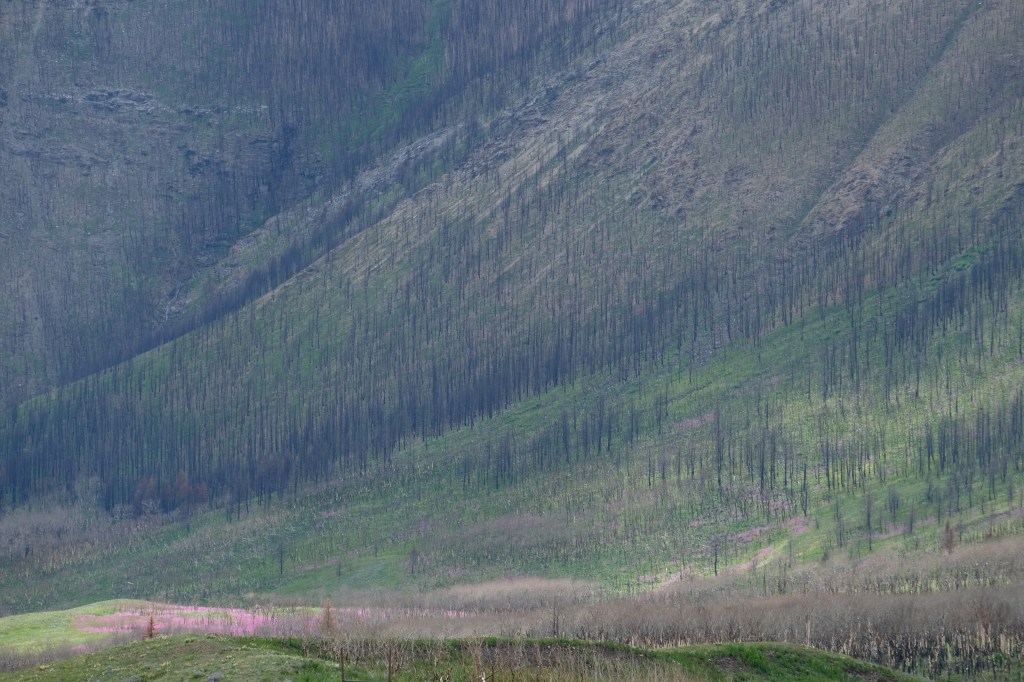
On August 29, 2017, during an intense summer thunderstorm, lightning struck a tree in southwestern British Columbia, about five miles west of the Continental Divide, on Kenow Mountain.  The tree burst into flame, and the fire spread. The forest had been primed by drought and heat… and after the storm blew through, a chinook wind developed.  By September 11 when gusts of over 90 mph drove the fire across the Continental Divide, fire crews didn’t stand a chance.  They had set irrigation sprinklers up to protect the park townsite, but when that roaring inferno arrived all they could do was to get out of the way and watch the fire storm burn through.  The town was saved, but almost half of the 195 sq.mile park burned.  And it wasn’t just the trees and grassland that burned; the fire was so intense that it burned the very soil, right down to the rocks and gravel.   It was an utter disaster.  It could have been worse, but the turbulent wind created back eddies that stalled the advance of the fire until a change in the weather settled it down and enabled the fire crews to get back in and start mopping it up.  Everywhere there were dead and wounded animals. The place ached with loss; all its life and stories and meaning seemed gone with the smoke.  News stories reported that the park was destroyed

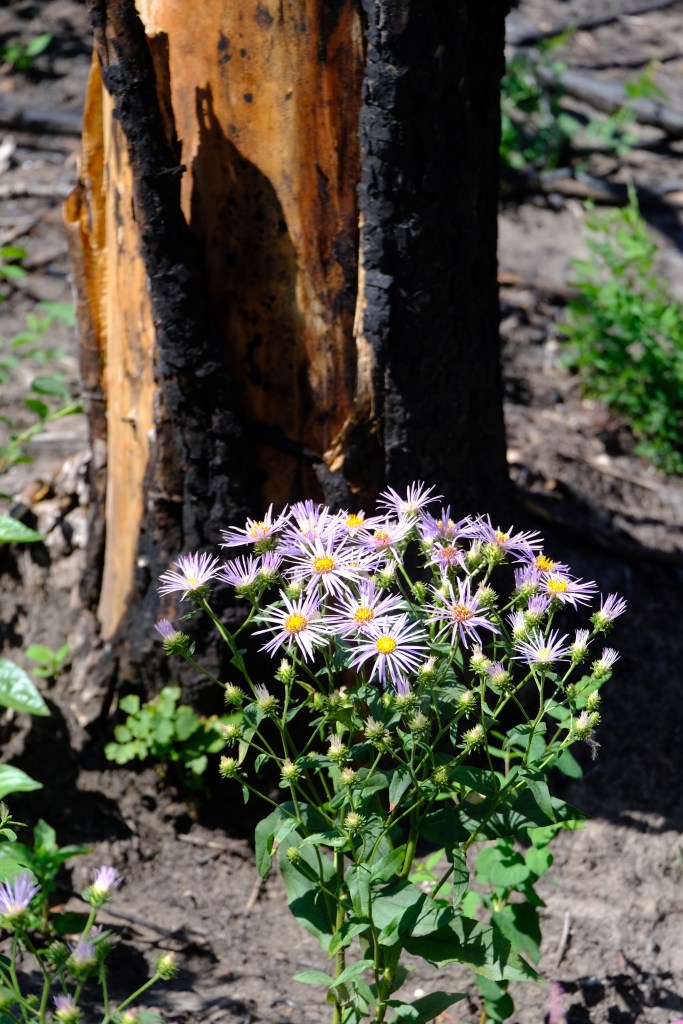
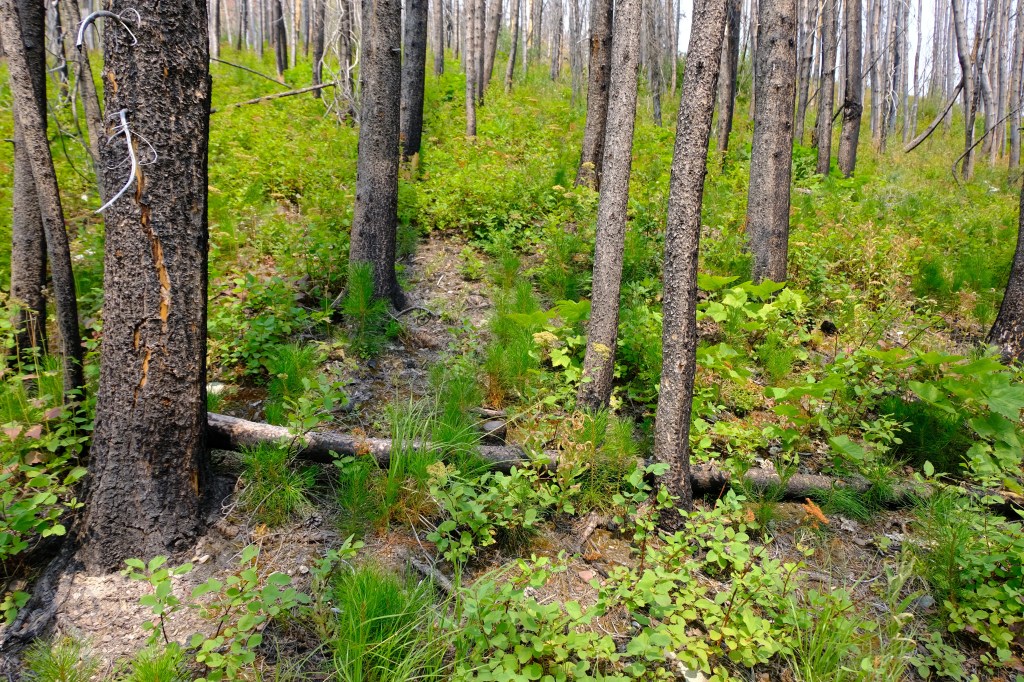
I visited the national park three weeks later.  It was burned to the very mountain tops, a bleak place of blackened tree trunks, grey ash and silence.  And in the charred prairie along the park road: brilliant green spikes of emerging grass. They didn’t look defiant, but they looked determined.  They knew the place was meant to be alive. Theirs was a wisdom deeper than ours.

In the ensuing decade, it has indeed come alive.  Many of the burned trees have fallen but as many more still stand, their boles now riddled with holes drilled by woodpeckers that have been attracted by all the wood-boring insects thriving in their new homes, homes created by flame. Absent the stifling shade of closed coniferous forest canopies, the understory has erupted in greenery.  When I worked in Waterton in the 1990s, I knew of three small patches of wild hollyhock; now those green pillars of floral beauty seem to be everywhere.  In summer, the flower mosaic has to be seen to be believed. Bighorn sheep feed on green slopes where encroaching forest had previously been shrinking their ranges.  Eagles still wheel above the summits; the bull trout still return to spawn. It isn’t the glorious place it was.  But it’s becoming the glorious place it’s now meant to be.  It wasn’t a disaster; it was a turn of the circle.

Immediately after the fire, teams of archaeologists descended on the park. The archaeologists, including two young Siksikaitsitapi (Blackfoot) researchers, saw the fire’s aftermath as a once-in-a-lifetime opportunity to find evidence of previous human occupation. With the vegetation and duff burned away, old campsites, structures and artifacts lay exposed in the ashes. Crews hastened to inventory the park’s archaeology before it could be obscured again by vegetation. They found camps and remains everywhere — a startling record of more than 12,000 years of continuous occupation by Niitsitapi. The archaeologists had to revise their story; this was not a place the Blackfeet visited occasionally or travelled through to trade or hunt; it was a centre of their existence. The Siksikaitsitapi are not just a prairie people — they are mountain people. But that had almost been forgotten.

The researchers decided to examine the mountaintops. They found seventeen different vision quest sites.

Dr. Mike Bruised Head, a Kainai researcher, described in his Ph.D. dissertation* how deeply troubled he felt. These Itaksiistsimoo’pi were meant to be places of fasting and visions. But almost nobody visited them anymore. There was little point. The mountains no longer had their original Indigenous names. A vision quest begins with an invocation of the mountain’s spirits, and that requires that the seeker pray to the mountain by its name. The names seemed to have vanished, to be replaced with names that had no relevance — like Mount Vimy, named after a battlefield in faraway France. In consultation with elders and other knowledge-keepers, Mike Bruised Head determined that its true name is Sakiimaapi.  One by one, he has been working to find the original names of those sacred mountains and restore Niitsitapi relationships with the place.  The park’s new interpretation centre uses those original names, and the interpretive signs sprouting up across the recovering landscape tell the deeper story of meaning that has emerged from those ashes.

This year, Parks Canada and the Blackfoot Confederacy announced a new Indigenous Guardians program that employs Siksikaitsitapi people to monitor and protect these sacred lands.  In doing so, the guardians will rediscover themselves, while offering new relationships and learnings to park visitors many of whom are, themselves, in search of deeper meaning and connection.

Barely a decade after disaster, the park is experiencing both an ecological rebirth and a renewal of its names, meanings and cultural relevance. It isn’t the place it was. It’s becoming something better.

When disaster strikes, it’s all we see. The despair and horror come from seeing the end of what we knew and loved, and the certain knowledge that there can be no going back. What is unknowable, in that awful moment, is what might come next; what possibilities await beneath the ashes.  But they are there, and after the flames burn down and the last wisps of smoke dissipate into the winds, the world will still be with us and it will have lost none of its magic. None. Some of its magic, in fact, will have been set free.

One of the most common trees in that wind-whipped landscape along the Lewis Overthrust is the lodgepole pine.  It forms dense stands that, as they mature, grow a dense, connected canopy that shades the ground below.  By the time a lodgepole pine forest has grown old, its thirsty roots and crowded canopy have suppressed or killed many of the other plants that were there when the trees were young and small.  And that’s okay; snowshoe hares, squirrels and crossbills like those dense old forests.  But there is a sense of suppressed sameness to a landscape dominated by those pines.

Fortunately, they burn.  The older and denser they are, the better they burn.  That’s one reason the Kenow fire was so intense; not only was it wind-driven but it was fueled by aging pine forests full of tree resin and crowded fuels.  Those trees are dead now, and the other kinds of plants whose growth they once suppressed will have their time in the sun again for a few decades.

But lodgepole pine is a paradox: it exists to be killed by fire, yet it relies on fire for its very existence.  Its cones are like rocks, sealed tight by resin, their seeds securely stored inside.  Fire burns off the resin coating and twists the cone scales open, releasing the seeds.  The dead lodgepole pine forests of Waterton Lakes National Parks, today, are full of live lodgepole pines: young ones, reaching their baby fingers joyfully into the sun beneath mountains that are rediscovering their ancient names, amid a coming together of Treaty People — both the Niitsitapi who were always here and the more recently arrived who hike the trails as tourists. The aftermath of disaster offers new hope of deep, real sorts of reconciliation.  Not just between peoples, but between people and place.

And this is what was unimaginable in the moment when the flames came.

There are other kinds of disasters. Sometimes an election’s outcome can feel like a disaster.

When those disasters beset us, it can be worth reflecting on the Kenow fire and the certain truth that magic sometimes is just waiting for its moment, even if we can’t see to the other side of the flame and smoke. Things that happen are never just events; they are teachings that are given to us by the living world that gives us all our life and all our meaning. Fires burn out; new things emerge. Sometimes better things. This is a truth given to us.

I’m trying to learn to think like a forest — to listen to the teachings of the world.  It is always the end of things; it is always the beginning of things.  The names of our mountains outlive the battlefields after which some might try to name them.

It will be okay.  It might, eventually, even be better.

* reference: Ninna Piiksii, Mike Bruised Head. 2022. The Colonial Impact of the Erasure of Blackfoot Miistakistsi place names in Paahtomahksikimi, Waterton Lakes National Park. Ph.D Thesis, Dept. of History, University of Lethbridge.