Mornings now are full of robins, some high in the weeping birch where they glow in the sunrise, others in the shadowed backyard oak, but most of them hidden in the big spruce trees that are scattered through the neighbourhoods. Later they will drop into mountain ash trees to feed on wizened fruit, or explore snow-free patches of ground to hunt awakening insects, but at first light they huddle in their roosts and sing together.
Some sing the familiar territorial robin song but most sing variants, like a kind of avian jazz improvisation. Collectively, it’s like a frenzied chorus of excitement but if you spot one, as often as not it will seem entranced, nearly immobile. Only its beak moves.
What are they singing for?
Biologists tell us that birdsong a functional thing: an expression of territoriality. Birds, we are told, sing to warn others to stay away, and in doing so they maximize the survival prospects of their mate and offspring during each short breeding season. It has survival value. But this is clearly not that; these birds are still en route to their summer homes. The collective cacophony that fills each half-lit morning and evening is from dozens of birds at once, temporarily massed in the riparian woods along the Highwood River as they participate in an annual robin festival which, clearly, fills them with emotion so intense that it spills over into song. There is nothing territorial about it at all.
Those birds seem to sing simply from the excitement of migration, the thrill of waking to another day of adventuring back across their continent, en masse. Migration is a great robin tradition, conducted en masse. It stirs hearts to song.
I’m just guessing at that; how are we to know? We live our own strange lives. But armies have marching songs and families travel to folk festivals and I remember singing in choirs when I was a boy — those moments when a hundred voices would rise into a crescendo of harmony that filled our hundred hearts with glory. To no useful purpose. And certainly not to assert a right to a breeding territory. Mostly it was just to revel in the joy and beauty of song — because, like robins, we could.
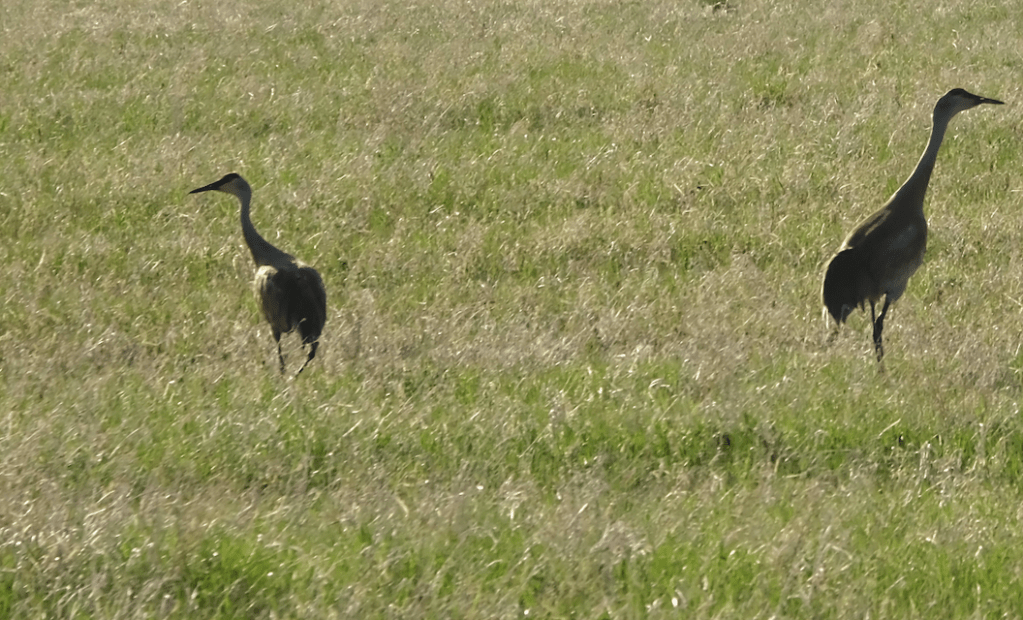
On the warmer evenings I sometimes take a drink and a blanket with me down to the riverside. There I settle myself into a folding chair and watch the valley fill with shadow as the water murmurs and chatters past me: river song. For the last hour of each day, pairs of geese pass overhead. Having spent the day on their new nesting territories along the river, they head down-valley at dusk to join up into temporary flocks again. I keep planning to go in search of them to find out what that’s all about, but have yet to do it. Probably it’s feeding time in the big fields. Or perhaps they spend the night together on the downstream reservoir before returning in twos and fours to their riverside homes in the morning. But there they go, each evening, enacting a daily ritual that is part of being a goose — looking forward, clearly, to gathering with friends and neighbours for a while, because that is how geese socialize.
When I was younger, I went out most evenings too, in search of other people. Sometimes to a party, occasionally to a bar, other times simply to wander around downtown. It was part of being a young adult human in a big city. I did it because I wanted to be around others; it gave me pleasure.
When I started paying attention to those goose couples and their evening flights, I found myself wondering why they did it — what survival value those flights have for them. On further reflection I found myself wondering why I automatically assumed it must have a functional value. Why do we think that way? We seem to have conditioned ourselves to look at other animals and explain their appearance, their behaviours and their life patterns in terms of survival value. In doing that, we reduce them to living mechanisms and elevate ourselves to the only beings whose lives have meaning beyond simple survival. Well, that’s certainly handy for us; it absolves a lot of sins. Think of all the birds that live and die in cages — not by their choices but by ours.
We say birds with brilliant plumages are colourful because it helps them attract mates or distract predators from their drab-coloured mates. We say birds with drab plumages are drab because it helps them hide. Birds sing to mark nesting territories. Birds migrate to escape bad weather or to find seasonal food sources. Everything, in an understanding of nature shaped by Descartian objectivism and Darwinian theory, has adaptive value. There is no room for spontaneous joy or simple pleasure in that objective, mechanistic view of nature; things do what they do simply to survive. It’s all DNA and design — for other creatures. Grim.
After a lifetime of observation and reflection, however, I have to believe we have schooled ourselves wrong. Animals are not simply assemblages of genes that sort themselves out into pre-configured behaviours that help them perpetuate the species. Animals are beings like ourselves, with complex social lives, ceremonies, relationships and simple pleasures. They don’t just survive; they live. They have fun. They feel sorrow. They adventure.
Late one summer afternoon I sat on a log beside the Panther River in the high backcountry of Banff National Park. There was an eagle nest near the top of a nearby cliff. An eagle appeared to the north, so high it was just a speck in the sky. As it drew near, something separated from it and began to plummet toward the earth. It was too small at that distance to make out what it was — probably a dead marmot or ground squirrel. The eagle twisted into a breathless dive, carving a crazy horizontal arc out of the blue, spiralling down from the sky, intersecting at last with its plummeting prey. With perfect timing, it scooped its victim out of the air and carved a sharp curve up along the mountain face before lighting gracefully at the edge of its eyrie where it posed for a long moment with both wings extended, before finally bending to feed its hungry youngsters.
I knew what I was seeing. That eagle was proud; he held that pose to bask in joy and glory. His dive had been a celebration of skill and freedom. It wasn’t necessary, but it was fun. He was taking delight in being who and what he was. He had given himself a moment of sheer, glorious pleasure, because he could.
Part of being who and what we are, at least in the objectivist, rational Western culture in which most of us were trained to understand the world, is to assume that any non-human other is also non-sentient. Animals are considered to operate primarily by instinct. Birds don’t think; they react. Behaviour is simply a response to external stimuli that helps the individual, and through it the species, survive. Only humans have intellect or creativity or complex emotions.
That eagle would beg to differ. The geese that gather to enjoy one another’s company each evening would beg to differ. A hundred robins paying joyous homage to the rising sun as they adventure north across the living face of their mosaic world would disagree too. At least they would if they cared — if they weren’t so absorbed in the glorious adventure of living in a world that was put here for them to make their own kinds of meaning, and to feel their own range of emotions, while living their own unique experiences.
We have no way of asking or knowing, but it would be interesting to learn how they interpret us. Perhaps their imaginations are more generous than ours.
I recall, one summer afternoon, hearing a robin singing nearby as I walked quietly along an early morning woodland trail. Unlike the usual robin song, this one was barely audible. I wouldn’t even have heard it it, had it not been so near. Curious, I picked my way forward slowly until, by lucky accident, I spotted it on a branch in the aspen canopy. It was a male robin, motionless amid the leaves, singing so softly it was almost like a whisper — in fact, in my notebook I recorded it as a “whisper song”.
There was a nest in the next tree, lower down, the tail and wingtip of the robin’s mate protruding over the edge where she sat motionless, patient, the smooth roundness of her four eggs warm against her brood patch; a mother-to-be.
He was singing to her.
I had stumbled into another couple’s love.
 Kevin Van Tighem