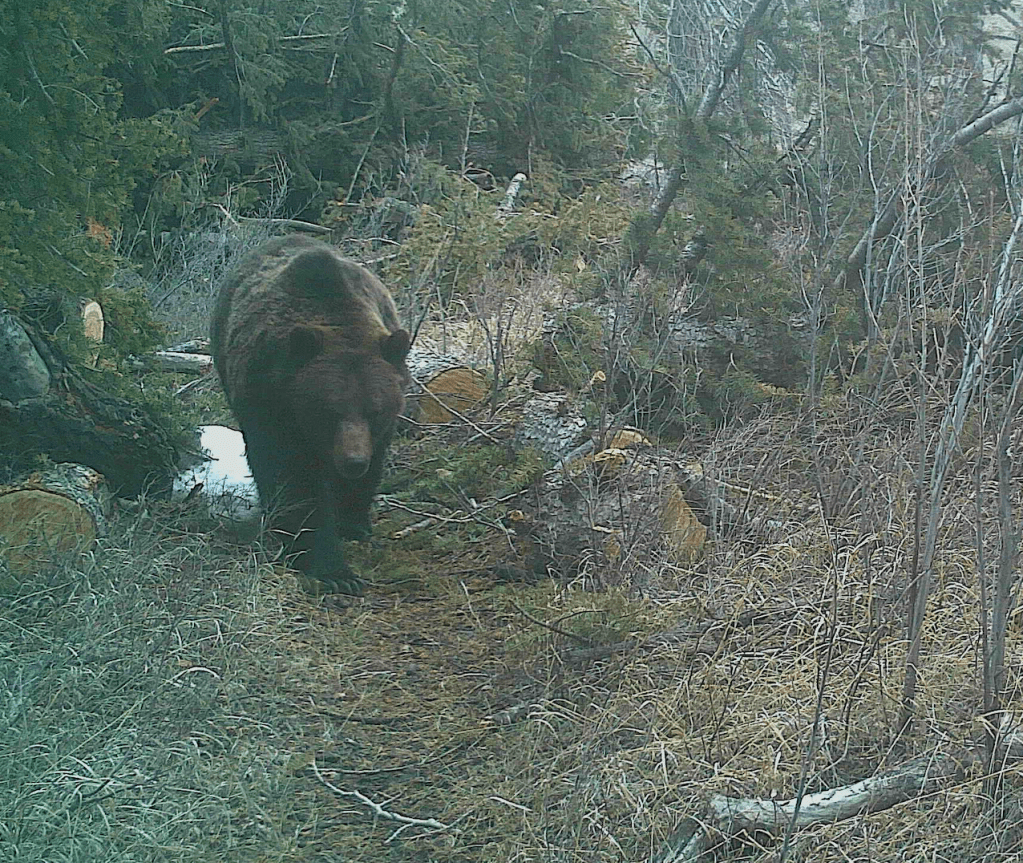
The grizzly bear that didn’t kill me became a problem bear two weeks later. I blundered into her two young-of-the-year cubs while bushwhacking through aspens in Waterton Lakes National Park one day. I smelled them first, then saw them — barely four metres away. I had forgotten my bear spray. Heart pounding with sudden fear, I looked around, and there was mom.
She turned, locked eyes with me, and I prepared to die. But instead of attacking, after a long moment she turned her back, granting me the opportunity to back out of the woods into the sunlight, and hurry back to my car. Having spent a lot of time around people who treated her with respect, she didn’t fear me, and so she didn’t kill me.
Unfortunately, a few days after our encounter, the mom and her cubs pried a couple of boards loose on an old wooden granary just across the park boundary and got themselves a meal of stored oats. The owner called Fish and Wildlife. A bear response team set culvert traps and caught the bears, radio-collared the mother, and relocated them to a remote mountain valley. They gave her a chance, just as she had given me one. Sadly, her radio collar soon sent out a mortality signal; the bear who spared me was dead.
That granary got a lot of bears in trouble over the years, until its owner finally allowed a conservation group to replace it with a bear-proof metal bin. And just like that, bears ceased to become “problems” there.
It wasn’t the bears that were the problem. It was the granary. Replacing it gave the rancher peace of mind, and protected the bears from temptation. It was a win-win solution except, unfortunately, for the mother grizzly who had spared my life. She and her cubs were among the 30% of translocated bears who fail to survive. I’ve always grieved her loss because she was a peaceful animal who showed that it doesn’t always have to go sideways when our lives intersect.
It still does, sometimes. Grizzlies occasionally kill domestic livestock, break into feed storage bins or even, rarely, attack or kill people. Fortunately, Alberta Fish and Wildlife employs well-trained staff who are attracted to their jobs by a desire to work near wildlife species that they love. And volunteer groups like the Waterton Biosphere Reserves Carnivores and Communities Program and local Bear Smart committees spend countless hours helping people coexist with a potentially dangerous — but usually peaceable — large carnivore. Even as numbers of both humans and grizzlies continue to climb in Alberta, conflicts continue to decline.
This is a success story, but the current Alberta government seems unwilling to acknowledge it.
Instead, in spite of the fact that grizzlies are still classified as a threatened species, Forestry and Parks Minister Todd Loewen has announced a plan to solve the grizzly “problem” by issuing hunting licenses to hunters eager for trophy kills. In a masterpiece of Orwellian prose, the decision to open the hunt against the advice of biologists was announced under the headline “Protection of life and property from problem wildlife”.
Pretending it’s about protecting life and property is a devious way of dressing up a trophy hunt as a public service. It isn’t. It’s pandering to a very small minority of Albertans who have been lobbying for a grizzly hunt ever since grizzly hunting was discontinued in the province in 2006. That minority includes Minister Loewen who, for many years, sold black bear hunts through his company Red Willow Outfitting, building deep connections with the province’s bear guiding and hunting community.
The bear vigilantes Loewen proposes to delegate under his revised Wildlife Act regulation, unlike Fish and Wildlife Officers, won’t have professional training. They will simply apply through Alberta’s hunting draw process. It’s safe to assume they won’t apply there because of a desire to find peaceful solutions; they will apply because of a desire to shoot a grizzly bear. This is not about protecting life and property. Call it what it is: a trophy hunt for a privileged few.
Grizzly bears have long been a point of intense public interest. Any decision as consequential as re-opening a grizzly hunt should have been made only after transparent, open public consultation. Instead, this wrong-headed decision was made behind closed doors by people who apparently fear public debate as much as they fear bears. Alberta’s grizzlies, and people, deserve better.
Dr. Stephen Herrero tallied up human injuries and deaths from grizzly bears in Alberta. He found an average of less than one such attack per year between 1960 and 1998. Most happened in national parks, where Todd Loewen’s hunters will never be allowed. Even though the province’s grizzly bear population has increased in recent decades, injuries and deaths caused by the bears have remained about the same.
With more bears and more people out there, a key reason why dangerous attacks have not increased is that today’s backcountry users are mostly well-informed about bear safety and have access to highly-effective defensive tools like capsaicin pepper-based bear sprays. It’s clear that the key to “protection of life and property” is to prevent attacks in the first place through education, information and modern defence technologies like bear spray.
If the Alberta government truly wants to protect human life and property, they should build on proven success — by hiring more professional bear managers to work proactively with land owners, recreationists and other backcountry users. Deputize untrained amateurs interested only in killing a bear is a recipe for disasters. In the rare instances when killing a bear is the only solution, that’s a wildlife officer’s job, and they know how to do it.
Dr. Sarah Elmeligi is a Canmore-based grizzly biologist who also happens to be Alberta’s only rural NDP MLA. She says: “The most recent data-based population estimate of grizzly bears is between 856 and 973 bears. Grizzly bears have been listed as threatened since 2010 due to a low population size. The Grizzly Bear Recovery Plan shows that between 2010 and 2015, ten grizzly bears were euthanized for management action, but the Minister is scaring Albertans into believing that grizzly attacks are commonplace and that the only way to solve the problem is to kill bears. This is just outright false. Killing bears doesn’t reduce conflict, it reduces populations. How can that be acceptable when at the same time we are committed to recovering the population?”
Good question. It’s one that should have been posed to the people of Alberta through a fulsome public consultation, supported by hard data and expert advice, before any decision about whether to let hunters kill a threatened species or to focus on other, better solutions.
Ironically, one outcome of turning armed vigilantes loose on Alberta’s grizzly population may be to decrease public safety — not increase it. Analysis by Steve Herrero and others show that most grizzly attacks on humans are defensive ones by mothers defending their young from perceived danger. The bear that didn’t kill me evidently didn’t see me as a threat. Would that have been the case if she’d had to dodge hunters and bullets before we met?
I’m glad I didn’t have to find out. I worry, now, that others will.
 Kevin Van Tighem