Lorne Fitch, P. Biol.
It’s an increasingly busy world, with more development, acres of pavement and noisier. Looking at our human footprint and the crush of people, all wanting more space, more resources, more of everything except wild country, wildlife and peace and quiet, it’s easy to fall into despair.
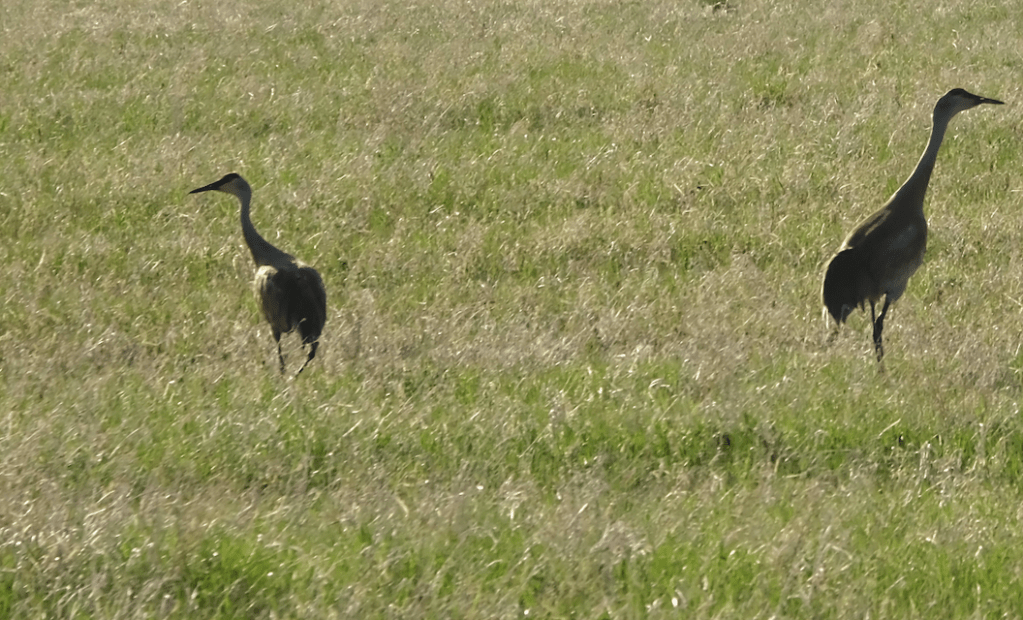
The northeast quarter of section 36 is our refuge, but it’s tiny in comparison to the developed world and what is required to maintain biodiversity and the other essential ecological services. It is a pretty quiet place though and so the rattling bugle call of a sandhill crane was unmistakable. One floated into the wetland on set wings, with a clear destination in mind.
We don’t know how old the wetland is. It probably began as a beaver dam and spread into a basin that collected and held water. Around the edges willows sprouted and in the interior cattails proliferated. All of this took time, maybe time beyond our imagining.
Every spring though, the chorus frogs wake up the wetland, and us. There probably was a time when the wetland was also awakened with the rattle of crane music. But in the previous three decades of our ownership no cranes graced the wetland, except maybe for a temporary look.
The historical breeding range of cranes was the Prairie Pothole Region, but up to 40 per cent of the wetlands there have been drained. Worse yet, wetland loss exceeds 90 per cent in parts of the region.
Early hunting and later habitat loss caused large declines in the population but crane numbers in Alberta seem to be steadily increasing with “excellent survival rates for adult and young birds,” according to biologists with the province. In the southwestern foothills this seems evident and might reflect some population migration north from similar habitats in the western US.
Nonetheless the birds are still considered Sensitive in Alberta, a reflection of habitat vulnerability that still defines population persistence. In spite of the designation Alberta opened up a hunt for sandhill cranes in 2020. My late colleague and friend Hugh Wollis raged against the hunt and asked penetrating, impertinent questions of federal and provincial bureaucrats over the dubious biological rationale and lack of supporting evidence.
Unkind thoughts of a mercenary government minister lobbying for a hunt with suspect motives were pushed to the side as I picked out not one but two birds through my binoculars. The standing bird was tall, towering over the wetland grasses, a gray body with brownish tones and a deep red “cap.” From the stance of the bird I could see why Aldo Leopold would write of cranes, “nobility, won in the march of aeons.”
Almost hidden by grass and cattails was the other bird, clearly sitting on a nest. To suggest this was a thrilling sight is the mildest of understatement! Seeing nesting cranes on the wetland created a feeling beyond the reach of words.
These cranes make the wetland and the NE of 36 more complex, more compelling and more complete. There is hope that eggs will hatch and the colts survive. In doing so, adult cranes might sense a place to return to, time and time again. In their annual return (fingers crossed) will be the endless ticking of an ecological clock.
A spring return will confer a particular distinction on the wetland, of a secure and safe place to nest. A crane wetland holds a patent of nobility, rising above the commonplace, providing a sense of timelessness. Wetlands provide wildness and as Leopold pointed out, “the crane is wildness incarnate.”
Maybe we might yet see the elaborate mating dance, the stretching of wings, pumping of heads, bowing and leaping into the air in a graceful and energetic pageant. And, to hear that iconic call, a signal of the wild and all the wild implies.
Leopold’s prophetic words on cranes registered: “When we hear his call we hear no mere bird. He is the symbol of our untameable past, of that incredible sweep of millennia which underlies and conditions the daily affairs of birds and men.”
The landscape of the NE of 36 seems timeless but of course it isn’t. It lies in and is influenced by a changing world, one of more cultivation, more land clearing, more wetland drainage as well as drought exacerbated by climate change. But for the moment we will cheer on the ray (and call) of hope brought by a pair of nesting sandhill cranes.
June 2024
Lorne Fitch is a Professional Biologist, a retired Fish and Wildlife Biologist and a past Adjunct Professor with the University of Calgary.

 Kevin Van Tighem