Hidden Creek: of Bull Trout, Floods and Logging

[Guest column by Lorne Fitch, P. Biol.; offered here as contrast to my telling of the same tale, below]
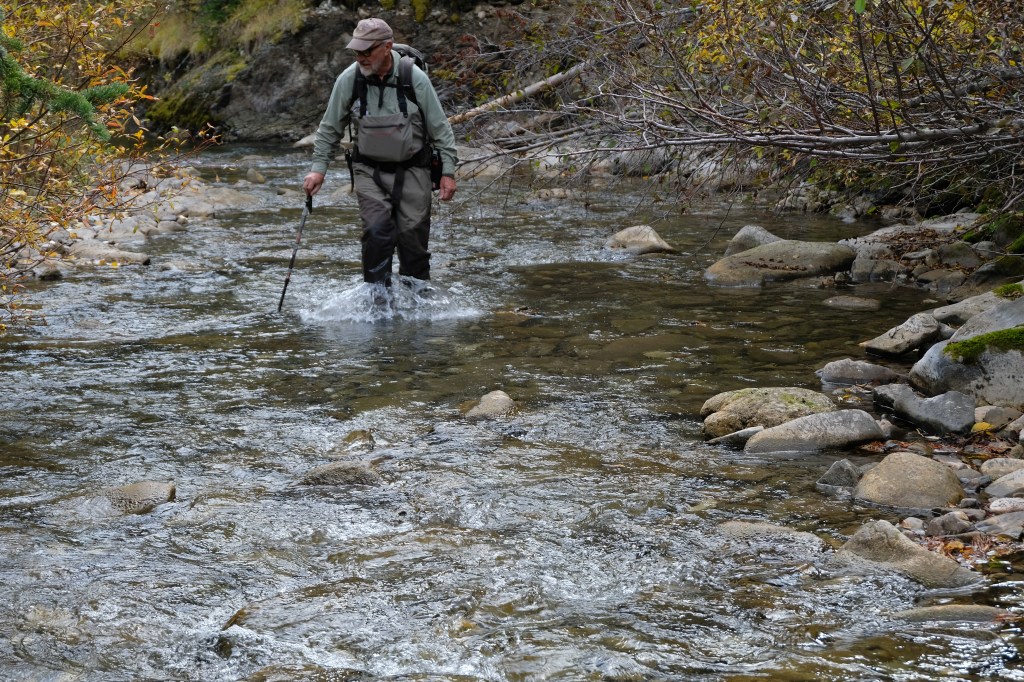
With an almost magnetic fidelity, bull trout have returned to spawn in Hidden Creek, an Oldman River tributary, probably for thousands of years. Documenting this through redd counts first started in 1995 and went to 1998. Systematic monitoring resumed in 2008 and has continued annually. I have returned, in late September, for years now to find and count bull trout redds. Recently I have waded the stream with some trepidation. 

Hidden Creek used to be the natal epicentre of bull trout spawning for the Oldman River watershed. Logging over the winter of 2012/13 coupled with a major flood in the spring of 2013 dealt the stream, and bull trout, an almost mortal blow.

Prior to the events of logging and a flood, the redd count hovered around fifty-four redds per year with a peak of 108. In 2013 post-flood redd numbers dropped slightly, from the average, to forty-one. From 2014 to 2019 the average dropped to less than ten redds per year, an eighty per cent reduction.

 Bull trout females are the ultimate arbiters of whether a stream possesses the right stuff for spawning. Many must have voted, with their fins, to take a pass on Hidden Creek. Where else they went is a mystery since other streams lack consistent monitoring and are also significantly impacted by logging, roading, motorized recreation and random camping.

Something about the combination of flood and logging created a perfect storm of changes in Hidden Creek, to the detriment of bull trout spawning. Hidden Creek is not gauged, so the magnitude of the 2013 flood and relation to other flood events is unknown.

Even after major floods in 1995 (the largest on record to date in the watershed) and 2005 bull trout still swarmed to Hidden Creek, to take advantage of an abundance of ground water, clean stream gravels and low water temperatures. Following the 1995 flood there was rapid increase in numbers of redds and although redd counts were not done immediately following the 2005 flood, redd counts were very high three years following that event. 

The North Belly River and Blakiston Creek, both in Waterton Lakes National Park, showed a similar rise in spawning success following the 1995 flood. There is no similar pattern for spawning events after the 2005 flood for these streams.

Comparing bull trout redd counts in Hidden Creek, the North Belly River, Blakiston Creek and Falls Creek (Ram River tributary), there seems to be no consistent and negative effect of major floods on spawning activity or on redd counts.

Flood impacts on trout might include factors such as flood timing, flood magnitude, duration of flooding and flood intensity. For fall spawners like bull trout, many of the factors of a spring flood are of a lesser concern except as they affect the  physical elements crucial for spawning success.

A consistent observation from the years following the 2013 flood in Hidden Creek was the lack of suitably-sized gravels for spawning. It was apparent that these smaller gravels had been flushed out of the system, leaving behind only larger rocks and cobble, unsuitable for spawning. Very few of the traditional spawning sites had gravels left and only a limited number of these had evidence of spawning. It appeared that the few spawners left were chasing a limited gravel supply.

Erosion from naturally unstable stream banks coupled with overland flow from logging clearcuts and roads coated the stream substrate with sediment for several years following 2013. Even seven years out from 2013 there was still a sediment supply lingering in pools, where no sediment used to occur. It doesn’t take much sediment to start limiting spawning success—the literature suggests as little as ten per cent over natural background sediment levels has a discernable effect.

Too much sediment likely dissuades a bull trout female from spawning. Even if she does, sediment interferes with the successful incubation of trout eggs laid in the gravels. The interstitial spaces between the gravels are clogged with sediment particles and this can smother the eggs, not allowing an exchange of oxygen-rich water or the removal of metabolic wastes. Trout fry might be unable to extricate themselves from the sediment-impacted gravel.

Bull trout are late bloomers, becoming sexually mature at about age five. If sediment levels inhibit successful reproduction, it sets the stage for fewer trout to mature and return, over time, to their natal stream. Year class failures echo through the entire watershed.

Although there is no discernible effect from flooding on spawning there may be a synergistic one resulting from logging. The effects of logging, especially clearcut harvests, are shown to change the hydrologic response of a watershed.

Removal of the forest canopy, coupled with roads, skid trails and soil compaction from logging quickens the response time of snowmelt and rainfall runoff, sometimes by orders of magnitude. Basically, logging results in more water, delivered more quickly to a stream. This occurs with any level of forest harvest, but more so with large clearcuts.  Flood peaks are elevated, and this intensifies the magnitude of a flood event. This translates into more energy for erosion and more sediment flushed into streams.

Since flows in Hidden Creek are not monitored it is difficult to determine to what degree logging increased natural flood flows. What was evident was the three tributary streams, that flow through cut blocks logged in the winter of 2012/2013, showed substantial new channel incisement, or downcutting. The logging road also intersected all of these streams. 

Upstream of the logged area, three additional tributaries of somewhat equal size were inspected—none showed any evidence of recent channel incisement. This would seem to indicate that runoff from the logged areas was substantially enhanced, over non-logged areas, leading to greater erosion.

Hidden Creek upstream of the logged areas did not have the same accumulations of sediment and it did not appear that gravel loss was as extreme as in downstream reaches. Unfortunately, the upper portion of Hidden Creek is mostly unavailable for spawning because a waterfall is a major obstruction.

It’s troubling that the tributary streams flowing through cut blocks showed only a perfunctory amount of erosion protection. Unlogged buffer zones were minimal, a few metres in width.  Sediment controls, in the form of sediment fences, were either missing, or poorly installed and unmaintained. These were already overwhelmed by large amounts of sediment by the fall of 2013.

Because of concerns over the logging of Hidden Creek, Forest Service staff apparently did regular winter inspections when logging was occurring, but there seemed to be little subsequent follow up to ensure erosion protection was in place and functioning. Self-regulation was ineffective, as was agency oversight.

Conclusions are hard to draw without more empirical evidence, but it seems that logging exacerbated the flood flows of 2013, likely caused a substantial amount of erosion from newly logged cut blocks, and increased the amount of erosion of naturally unstable stream banks. This deposited a substantial amount of sediment in the lower reaches of Hidden Creek and scoured out much of the suitably-sized spawning gravels.

To compound the problem, runoff from an August 2013 rain storm turned Hidden Creek into a muddy soup. Other streams in the area, subject to the same weather event, remained clear indicating that logging had increased the erosion potential substantially in Hidden Creek.

Bull trout spawned in the autumn of 2013, creating forty-one redds. However, it is unknown whether that spawning effort produced new trout. If incubation was successful, that year class, following sexual maturity should have shown up in 2018 and 2019. But they didn’t. Subsequent to 2013, redds counts dropped alarmingly, down to one redd in 2019.

Redd counts in 2020 showed thirty-four redds, somewhat of a resurgence, but dropped to nineteen in 2022 and to fifteen in 2023. This is far from the long-term average. It shows the effects of logging can linger and a landscape can hum like an anvil long after the hammer of development has hit.

Signs of recovery occurred after six years. This is likely related to flushing of sediments from gravel by subsequent high flow events and the recruitment of new gravels with normal bedload movement. It is easy to leap to a conclusion based on one year of higher redd counts but continued monitoring shows the positive trend has not continued.

One winter of logging has equated to at least six and probably ten years of lost bull trout spawning and population recruitment for much of the Oldman watershed. For a species that is designated as Threatened, this is a near mortal blow. It begs an essential question—can sensitive watersheds essential to the survival of trout species at risk be logged without serious impacts to those populations?

Whatever the Forest Service and the forest sector say, Hidden Creek provides an unequivocal answer.

September 2023

Lorne Fitch is a Professional Biologist, a retired Fish and Wildlife Biologist and a former Adjunct Professor with the University of Calgary
Hope Renewed

Lorne Fitch has been keeping his finger on the pulse of the Oldman River for over seventeen years.  He doesn’t check water levels or water temperatures, even though he is acutely aware of them.  Instead, he keeps track of the bull trout.

Bull trout are Alberta’s provincial fish – a wise choice, given that they largely evolved here and their migratory lifestyle ties together entire river systems.  Some bull trout live year round in mountain streams, never growing much larger than a frying pan. Over the years, too many of those ended up in frying pans, unfortunately; one reason the species is now classified as threatened.

But a lot of young bull trout migrate downstream to big prairie rivers where the food is abundant.  There they grow into meter-long giants that lurk in the bottom of pools and prey on other fish.  As water levels decline in summer, they begin to work their way upstream until they arrive in the small mountain streams where they were born. There the big females scoop out trenches in the gravel at the tails of long pools, creating nests called redds where they discharge their eggs while smaller males crowd close and release milt to fertilize them.  The eggs become buried in the gravel and survive there because well-oxygenated water constantly percolates up from below and washes away silt and algae that might otherwise suffocate the eggs or fry.

You don’t get clean gravel stream beds in abused landscapes.  Where aggressive industrial logging operations strip away ground cover and expose raw soil to the elements, runoff brings so much eroded dirt that it overwhelms the ability of small creeks to flush it away.  Although the largest spawners can bury their eggs in gravel large enough to resist heavy stream flows, the big dirty floods that drain over-logged, over-roaded or over-grazed land can blow those spawning redds out.  Coal strip mines, gravel extraction and motorized recreation all have the potential to ruin a stream for bull trout.  And we’ve got all of those things now, in places where bull trout used to thrive. Where streams used to be healthy.  Because the land was healthy.

Hidden Creek is a tributary of the Oldman that lives up to its name. There are no permanent roads in its drainage.  To get there, one must wade across the upper Oldman and hike up a side valley where the only sounds are water, wind and birds.  It’s always been a critical spawning stream for bull trout because of its clean gravel bed and abundant groundwater that saturates the surrounding slopes and wells up into the stream bed at frequent intervals.

The best year Lorne has recorded on Hidden Creek, he and his colleagues found more than 100 bull trout redds.  Over most of the years the average was about fifty.  But things changed ten years ago.  Spray Lakes Sawmills carved an access road up the valley and clearcut several large patches of timber on the valley slope.  The loggers had barely finished backing out of the valley when the 2013 flood event hit the Eastern Slopes.  Massive runoff from those clearcuts magnified what was already a huge flow and the creek blew out several sidehills while flushing much of that good gravel downstream, scouring out the best spawning reaches.

Bull trout nearly vanished.  The lowest count of redds in recent years was one.  One single female bull trout managed to find a place to deposit her eggs.  That one bull trout was a living measure of the loss of watershed health, because bull trout can only thrive in healthy watersheds. That’s why the species is already gone from other nearby streams — they got hurt harder, and sooner, than Hidden Creek.  Now, it appeared, even Hidden Creek had become another failure.

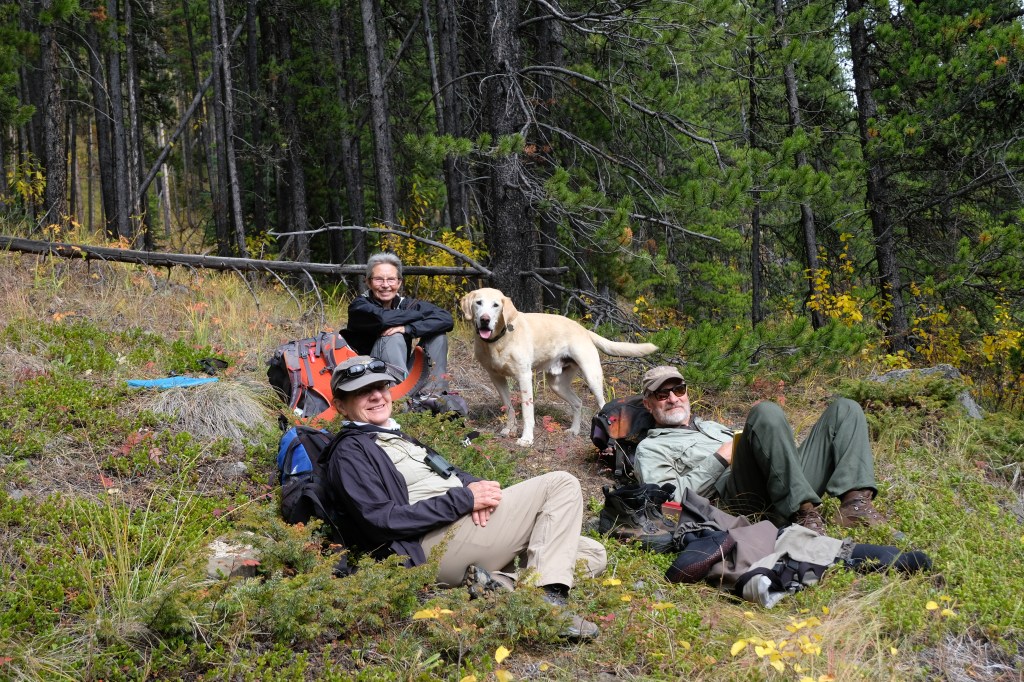
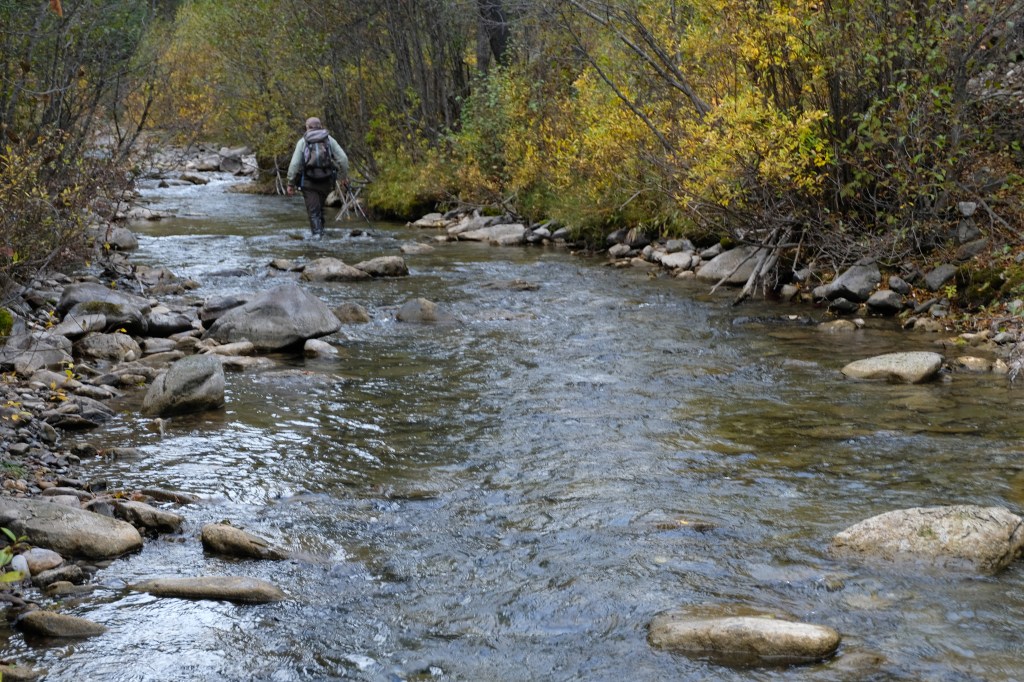
This September Lorne invited me to join him on his annual bull trout spawning survey.  With Cheryl Bradley and Gail we waded the Oldman, picked our way through a replanted clearcut, and rendezvoused with the creek a kilometre or so above its confluence with the Oldman.  While Cheryl and Gail continued up the trail to explore the valley, Lorne and I put on our chest waders and stepped into the creek to begin a long upstream transect.

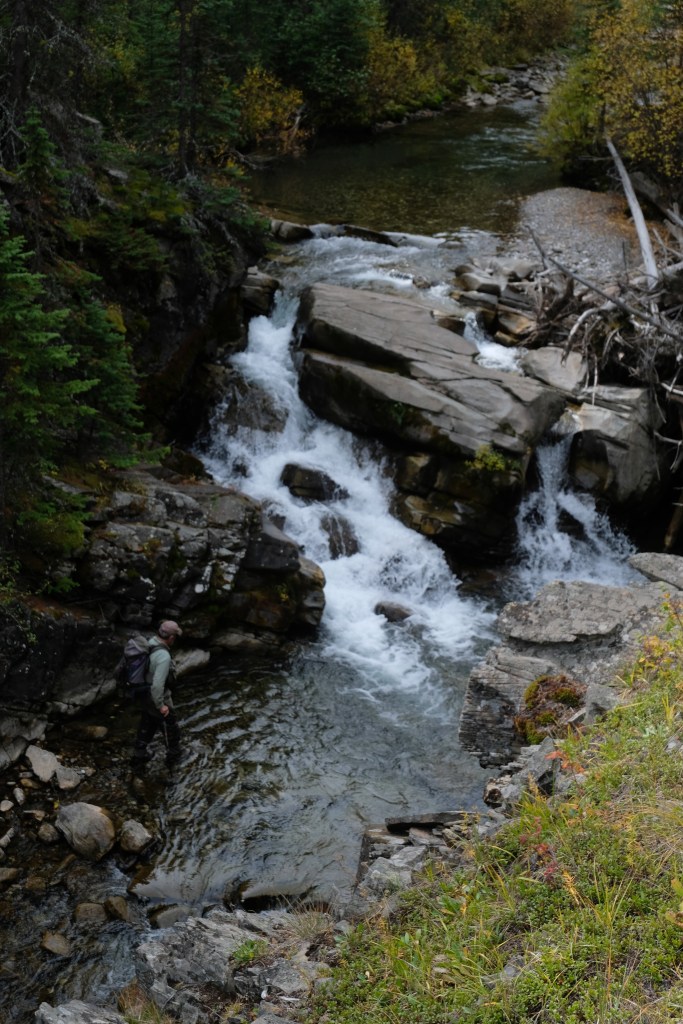
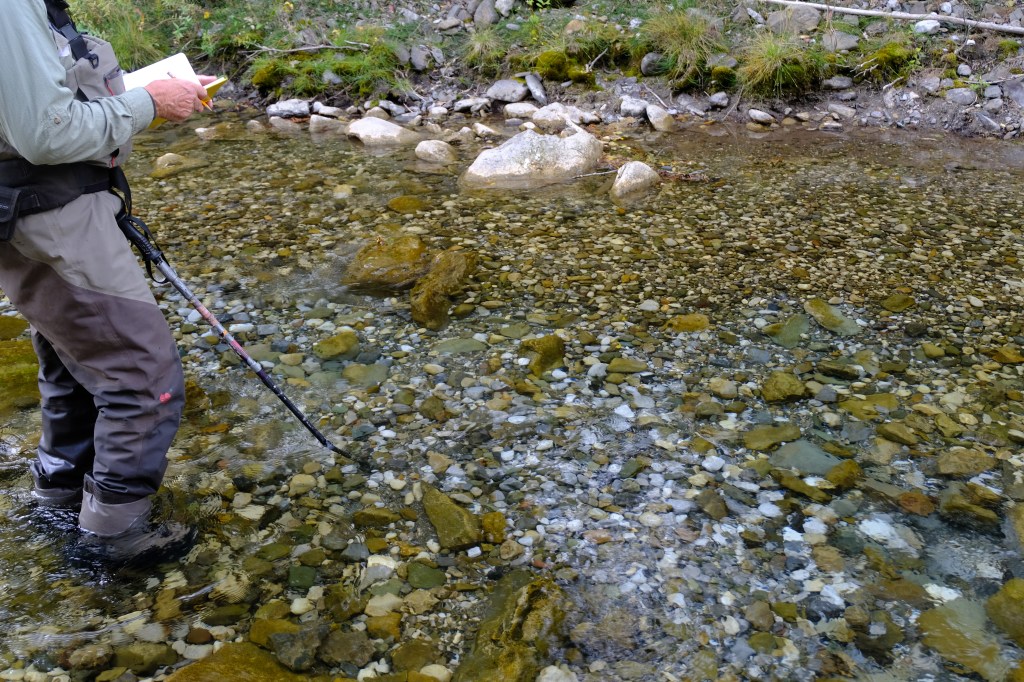
Not a redd to be seen, at first. There wasn’t much in the way of promising-looking spawning gravel either; ten years after the 2013 flood the stream still hasn’t been able to replace much of what washed away.  Here and there we saw red survey ribbons on stream side branches marking where previous years’ survey crews had found redds, but the stream bottom was cobbly and empty.  At one promising-looking spot where he had almost always found redds before Lorne stared at the water for a long time before turning to continue upstream, muttering, “I don’t know. I just don’t know…”  I could hear in his voice what I could feel in my sinking heart.

But finally, after a kilometre of hiking we found a redd at the tail of a deep pool.  The gravel was clean and devoid of algae or silt, partly mounded and partly hollowed out, showing where a big bull trout had scooped it out and then refilled it as she moved slowly upstream, releasing eggs. She must have been big; it was surprising to see the size of some of the stones she’d moved.  “That’s why the really big females are so important,” Lorne explained. “They’re the ones that can get their eggs deep enough in material that can withstand the spring runoff flows.”

As canyon walls began to rise on either side of us, it became an increasingly good day.  By the time we met our companions for lunch at an impassable cascade, Lorne had counted fifteen redds.  That’s well down from the average count before the logging equipment arrived in the valley to destabilize the landscape, but also well up from the lowest counts after the big 2013 flood event.

We didn’t see any bull trout, just the occasional cutthroat and a couple of sizeable schools of mountain whitefish.  Those smaller fish stay in the creek all year round, but the bull trout had evidently retired downstream to the deeper pools where they spend the winter.

Native trout like the bull trout aren’t just a thing for anglers. Their relationship with the Eastern Slopes and the streams that are born there goes back deep in time, far deeper than even than the oldest Indigenous culture. Our modern interest in catching them, or just watching them, has no meaning to them.  They live in their own ancient reality, intimately tied to the patterns and processes of their part of a living green planet.  They are who they are.  It was a privilege to visit their home place, irrelevant though we might be to them.

For all their intrinsic value, though, bull trout are also a measure of our success, or failure, at living here well.  We have the capacity to destroy them simply because of our hunger for stuff and the technological prowess with which we pursue that hunger.  We don’t need to catch and release the big female bull trout that are so essential to the success of the population.  We don’t need to practice the kind of industrial-scale forestry that destabilizes whole watersheds and disrupts groundwater recharge so dramatically.  We certainly don’t need to extract coal from those headwater drainages.  We can use land lightly, instead of leaving it tracked up and compacted with wheels. If we get things right, bull trout will persist. If we don’t, they won’t.

Lorne and I talked about the good things we remember from our childhood, when bull trout were still abundant and the Eastern Slopes a paradise for those of us lucky enough to grow up there.  We are both writers and we put a lot of words around our solastalgia and regret.  It used to be that that sort of prose motivated conservation action because those who read it still believed in the future and could be fired up by indignation and anger.

Now, however, we seem to live in an era of worry and despair.  People don’t want to be reminded of what they have lost because it simply deepens their gloom and heightens their feelings of powerlessness.  Reminding people of the good old days doesn’t motivate; it paralyzes. That’s one reason I hesitated before sitting down to write this piece.

But there is this: today we found fifteen spawning redds of a fish that had almost vanished from Hidden Creek just a few years ago.  Where off-road vehicle traffic and irresponsible logging had damaged the creek banks, even way up the valley, we found willow thickets that had been planted by volunteers who hiked in and worked hard to give the creek its health back.  There were no tire tracks to be seen. The logged areas are damaged, but regrowing.  And there will be no coal mines in that valley. People mobilized to make sure of that.

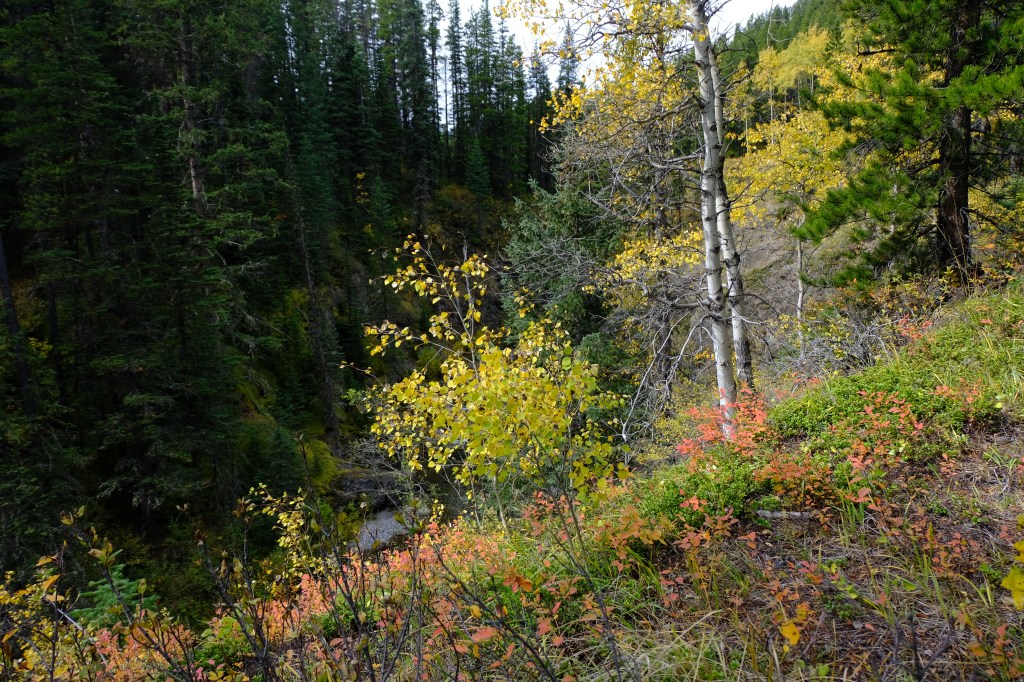
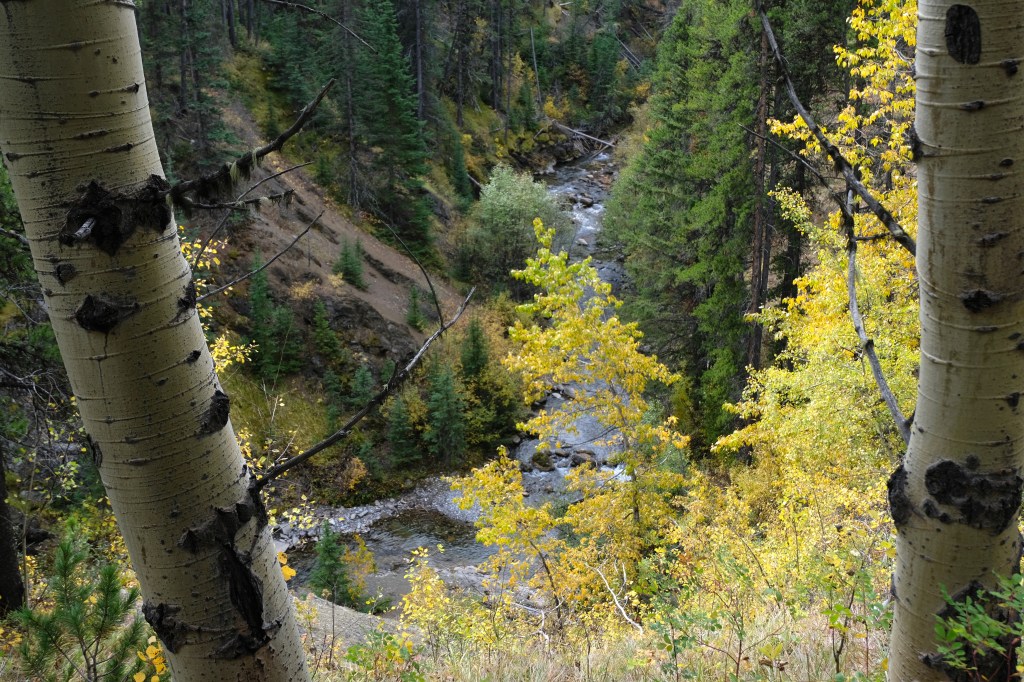
There were grizzly tracks on the trail.  The breeze was sweet and clean, and the aspens glowed golden with hope.  It was a very good day.

The mess we are in today is the product of the past — of choices we made and the things we did before now.  We had the best of all chances and we squandered it.  Lorne and I are right to regret what we remember because the past we remember is over. It’s not coming back.

But what will come next need not necessarily be less. Those fresh trout redds spoke to us not just of the meaning of this place but of second chances. The future could even be better than what we remember; it depends on the choices we make and the things we do today and tomorrow.  We can make good choices.  We can make sure that others don’t make bad ones. We just have to care enough, try enough and dream enough. And it’s already happening.

The bull trout are still there, waiting to let us know we got it right. Imagine one hundred huge bull trout spawning in a green and intact valley whose waters flow clear and sweet to communities whose people choose to live in a good way with a place they love and respect. Hope is imagination, acted upon.

I came back from Hidden Creek tired, sore and old, but I also came back with hope renewed. We haven’t left our best possibilities behind us; we create new ones daily.  Next year those giant trout will reappear like the annual miracle that they are, nosing their way upstream from pool to pool until they sense the sweet, cold water rising up through clean gravel. They will hang there, fins slowly moving in the current, like so many generations of bull trout have done before, on the verge of that annual spawning ecstasy when they release the promise of new life into a living stream that drains a land fairly pulsing with life and meaning. Still. 

Our very best nature could actually lie ahead of us. We cannot change the past, but our choices will shape the future.  Hidden Creek reminded me, yesterday, that imagination can be as rich as memory, and that nature can be patient. It can take us somewhere better than where we are, than where we’ve been.

If we choose.