July 9 2023
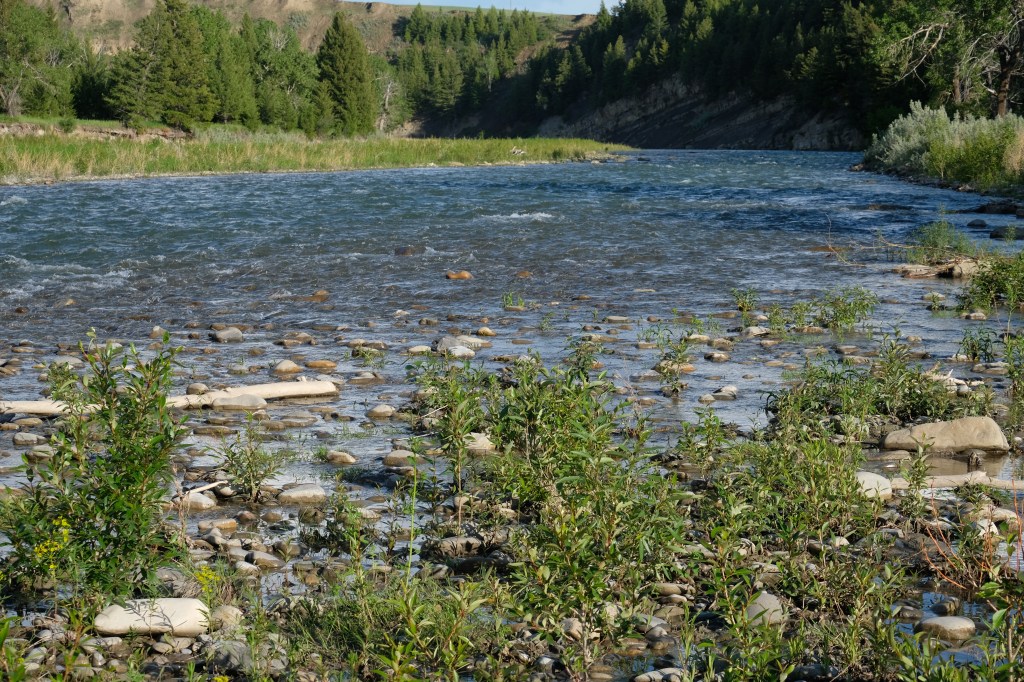
The river is in ongoing negotiation with the land over who owns that edge where willows crowd down to the cobbles and poplars lean back into the sun. They even dispute ownership of the cliffs along the outside bends. It’s a conversation that goes on season after season and nothing is every fully resolved.
During the spring spate, the river makes its most forceful and compelling case. It breaks off bits of cliff and takes possession of the cottonwood groves. But it can’t sustain such passion, and the flows slack off, and the land quietly asserts its ownership; cobbly islands emerge and new poplars sprout on them. Winter brings a truce but then it’s spring and the whole conversation picks up where it left off.
This being summer, the river was too warm for fishing today but that meant it was just right for sitting in it and contemplating the life that goes on along that contested riparian edge. Something good was evidently hatching out of the river, because three trout were rising in the slick run just upstream from my seat. Two little splashers and a seriously large fish that pushed up a big bulge of river each time it rose. A kingbird liked the looks of that hatch too, because it dove from the Douglas fir three times and, osprey-like, splashed the surface as it picked off floating mayflies. Then it was gone; back from the river edge and up to its nest in our windbreak.
That left the cedar waxwings. They weren’t willing to take the same risks as the kingbird, choosing instead to take turns fluttering out into open sky, grabbing an insect in midair, and returning to their perches on a half-dead fir that leans out from the edge of a cliff. It won’t last many seasons more before it falls victim to one of the river’s more convincing arguments and becomes flotsam.
The waxwings seem to like company; they feed in twos and threes, taking turns darting out. Once two waxwings went out after the same insect, realized what they had done, and both politely turned away, leaving the fortunate survivor to sail away in the sullen warm breeze wafting down the valley. Perhaps safe, perhaps not; overhead the violet-green, rough-winged and tree swallows were on constant patrol for insect life lifting into the sky from the river.
Two spotted sandpipers came shimmering down the river and veered suddenly at the unexpected sight of the bemused human sitting in the middle of a riffle. They landed in the pale cobbles, teetering, peeping, scurrying in and out of the willow fringe as they fed their way downstream on that contested terrain. They have fluffy little babies somewhere on that mid-stream island but much as I like to see them I tend to leave them undisturbed. They and their river have their own matters to attend to.
The riparian fringe is wider now as the river recedes to its summer low flow. Mint is starting to bloom. There are peeled willow stems half-in, half-out of the current edge, and beaver trails up into the thickets. Most of the life I see along the river edge is diurnal because that’s when I’m there, but the tracks in the sandbars and mud deposits are evidence that it continues through the night. Mink, sometimes raccoon, sandpiper, deer, bears. They all have reasons for bearing witness to those negotiations between water and land. Mostly involving food, because it’s a fertile place, and always wet.
One day I put a trail camera on a gravel bar, leaning against a willow, and later retrieved dozens of photos of robins who evidently spend more time under the river willows than I had imagined. And a northern waterthrush. Who knew? The river and the land knew, of course. It’s always been part of their conversation.
Another time I saw an otter. Exotic to me; well-known to the river and presented by it as evidence of why that contested strip should be considered river property. The land replies with deer and skunks.
The issue remains unsettled, and probably always will; an entirely satisfactory situation for all other interested parties.
 Kevin Van Tighem